

You do not need 50 online-income ideas. You need one real method which fits your skill, free time, money situation, and your courage to find customers.
So, can you really make money online? Yes, you can. Many people doing it already. But internet itself not giving money. It is only a road. Money comes when you give some value through that road.
Usually, people earn online by selling one of these things:
- Their time
- Their skills
- A useful product
- People’s attention
- Their capital or money
This point changed my thinking. Earlier, I was searching for easy websites which pay fast. I found many promises, but very little real value. Later I understood, faster income mostly needs direct work. You help one customer, finish one task, then receive payment.
Scalable methods are different. Blogging, YouTube, digital products, or affiliate work may grow bigger, but usually take more time. Sometimes months. Sometimes longer.
There is no single safest or best answer for how to earn money online. A student, office worker, parent, and skilled designer cannot follow same path.
Your best choice depends on your skill, budget, available hours, income goal, and how much risk you can handle. This guide will help you compare the realistic ways to make money online, choose one path, and start carefully.
Income is possible. But it is never guaranteed.
How Do People Earn Money Online?
Earning money online means providing work, expertise, products, access to an audience, or capital through an internet-based platform or business.
But online money not coming from internet itself. A real person, company, customer, advertiser, or buyer must pay you. This point sounds simple, still many beginners miss it. They search for secret apps, easy tricks, and instant income. I also once thought online earning works like some machine. Open laptop, click few things, money comes. Real life is different.
There are five main online income models.
- Employment: A company hires you for remote work and pays salary or wages. This is usually more stable. But your working hours and freedom may be limited.
- Services: A client pays for your time or result. Writing, design, coding, tutoring, video editing, and virtual assistant work belong here. For many beginners, services can bring the first useful income faster.
- Products: You sell physical goods or digital items, such as ebooks, templates, courses, software, or handmade products. One product may sell many times. Still, people must want it. Marketing is not optional.
- Audience monetization: Bloggers, YouTubers, and social media creators earn from ads, sponsors, memberships, affiliate links, or followers. Starting is cheap. Earning usually comes slow because trust takes time.
- Capital income: You invest money and may earn interest, dividends, rent, or returns. This needs capital and includes risk. It is not quick online income.
So, is online income a job or business? It can be both. Employment gives more predictability. Services give faster chances. Products and audiences may grow bigger, but take patience. The most reliable model is the one where you solve a real problem for a real paying person.
Finally, read these world’s highest money maker’s stories to work more hard and to inspire.
Which Online Earning Method Is Best for You?
The best way to earn money online is not same for every person. Your friend may earn from YouTube. Another person may get money from freelance work. But it does not mean you also get same result.
First, look at what you already have.
Do you have a useful skill? How many hours can you work? Can you wait three or six months? Do you need money this week? These small questions change everything.
Many beginners choose an online side hustle because someone showed a big earning screenshot. Later, they find the work is slow, hard, or needs money. I have seen people start blogging when they urgently need income. They write for two months, get little traffic, then stop. The method was not bad. The timing was wrong.
Use this table before choosing.
| Method | Startup cost | First-income speed | Skill level | Predictability | Income ceiling |
|---|---|---|---|---|---|
| Freelance service | Low | Fast | Beginner–expert | Medium | High |
| Remote online job | Low | Medium | Beginner–expert | High | Medium–high |
| Tutoring or consulting | Low | Fast | Intermediate | Medium | High |
| Digital products | Low–medium | Slow | Intermediate | Low at first | High |
| Content creation | Low–medium | Slow | Beginner–expert | Low | High |
| Affiliate marketing | Low–medium | Slow | Intermediate | Low | High |
| Ecommerce | Medium–high | Medium | Intermediate | Low | High |
| Microtasks or surveys | Low | Fast | Beginner | Low | Very low |
If you need the fastest legitimate choice, sell a service you already know. Maybe writing, video editing, tutoring, design, bookkeeping, data work, or social media support. You can start with free tools and contact possible clients directly.
For safer and more regular income, look for a verified remote online job. Check the company website, job details, email address, and payment terms. Never pay money to receive work.
If you have no experience, do not think you have nothing. You may know how to organize files, reply to messages, speak two languages, teach school lessons, or use basic office tools. Virtual assistance and simple, narrow services can be beginner-friendly online income ideas.
For higher future income, digital products, software, digital business, content, and audience businesses can grow well. But they are slow. A new blog or YouTube channel is a poor choice when rent is due soon.
Surveys may give small money fast, but the income ceiling stays very low. Use them only for extra pocket money.
Choose online work based on skills, time, budget, and risk. Do not choose only by income promises. The right method should fit your real life, not somebody else’s success story.
1. Sell a Freelance Service Online
Selling a service is one of the fastest honest ways to earn money online. You do not wait six months for blog traffic. You do not need stock, office, or big money. You find one person having a problem, then you help fix that problem.
Simple idea. But starting feels not simple.
Many beginners open Upwork or Fiverr profile and sit there. Two days. Ten days. No message comes. Then they think freelancing is dead, or only experts get freelance jobs online. Usually, the real issue is not talent. The offer is too wide.
“I am a video editor” tells your skill.
“I turn one long coaching video into five short clips with captions” tells what buyer gets.
That small change matter a lot.
What service can you sell online?
Look at work you already know, even little bit. Writing and editing, graphic design, presentation design, video editing, social media management, virtual assistance, bookkeeping, web design, software development, SEO, paid advertising, translation, customer support, data analysis, resume writing and LinkedIn improvement all can become online services to sell.
AI workflow automation is also growing. Small companies need people who can connect forms, emails, spreadsheets, customer records, and AI tools. Still, do not sell “I use AI.” Client not care much. Sell the saved time or solved headache.
Use this small framework:
Skill → Problem → Offer → Proof
For example:
- Skill: Video editing
- Problem: A coach makes long videos, but viewers leave early
- Offer: Turn one 30-minute video into five captioned short clips
- Proof: Create two sample clips using your own or permitted footage
- Result: Buyer quickly see what you can do
This is also how to start freelancing with no experience. You may have no paid client, but you can still make proof. Create sample website. Rewrite a weak product page. Design a pretend presentation. Audit a local business social page. Never fake a client name or result. Just mark it as a sample project.
How to get your first freelance client
Start small and narrow.
- Choose one customer group, such as dentists, coaches, local shops, or software companies.
- Write three costly or boring problems they face.
- Turn one problem into one clear deliverable.
- Make two samples related to that work.
- Put them on a simple portfolio page.
- Contact 20 possible clients with a personal note.
- Offer a small paid test project.
- After good delivery, ask for testimonial and referral.
Do not send 100 copied proposals saying, “Dear Sir, I can do your project.” People can feel copied message very fast. Mention something real from their website, video, job post, or business.
You can also do freelancing without Upwork. Contact businesses through LinkedIn, email, professional groups, local networks, past coworkers, and referrals. Marketplaces give access to buyers, but they also bring heavy price competition.
For pricing, fixed project price is easier when the output is clear. Hourly price works better when the scope may keep changing. Always write what is included, deadline, revision limit, payment date, and ownership terms. For a new direct client, ask for a deposit or use milestone payment.
Be careful also. The US Federal Trade Commission says honest employers will not ask you to pay money to get a job. It also advises checking the company name with words like “scam,” “review,” or “complaint.” Never send money to unlock work, release payment, or buy crypto for a client.
Freelancing is not a tiny side world now. Upwork’s 2025 study said 28% of surveyed skilled US knowledge workers were working as freelancers or independent professionals. It estimated that this group generated $1.5 trillion during 2024. These are US market figures, not a promise of beginner income.
Your first target should not be huge monthly earning. Make one useful offer. Show proof. Get one real buyer. Your first $100 freelancing usually begins there, not from making another marketplace profile.
2. Apply for Remote Online Jobs
You can work online without becoming freelancer. Many companies hire people as full-time or online part-time workers. You receive fixed work, manager support, training, and mostly a regular monthly payment. For many beginners, this feels safer than searching new clients every week.
Remote work is not some small idea now. In March 2026, 22.6% of working people in the United States worked from home or did telework for pay.
Common legitimate online jobs include:
- Customer support
- Virtual assistance
- Sales development
- Technical support
- Bookkeeping
- Content moderation
- Recruiting coordination
- Project or remote operations support
- Online research
Some remote jobs with no experience also exist. Customer support, junior sales, scheduling, and virtual assistant jobs may give basic training. Still, you need good written communication, reliable internet, and knowledge of simple tools like email, spreadsheets, video meetings, and shared documents.
I see many people applying for every job they find. This usually wastes time. Read the job duties first. Check whether the working hours match your country and time zone. Make a resume for that role, not one common resume for 50 different jobs.
Data-entry and transcription work can be real, but be careful. Rates may be low, work may not come daily, and fake listings are many. The US Federal Trade Commission warns that scammers sometimes copy real company names and offer remote data-entry or translator jobs to steal money or personal details.
Before applying, visit the company’s real website. Search its name with words like “scam,” “review,” and “complaint.” Never pay registration, training, equipment, or account-opening money to get a job. Honest employers do not ask job seekers to pay for the promise of work.
A remote job may suit you when you need fixed hours, stable income, team help, and less client hunting. Freelancing may suit you better when you want flexible timing, choose your own projects, and control how much you charge.
3. Teach or Advise People Online
You may already know one thing better than another person. Maybe school maths, spoken English, guitar, coding, fitness basics, or job interview skills. That knowledge can become income. Many people now search for online tutoring jobs because teaching from home need less setup, and you can start with one student only.
You do not always need teaching degree. For school tutoring, language instruction, or test preparation, strong subject knowledge and clear explaining matter a lot. Some platforms may ask degree or certificate, mainly for formal teaching work. But private students often look at your result, sample class, reviews, and how patient you are.
Finding students is little hard in starting. I have seen people create big course first, then no buyer came. Better start small.
Try this:
- Pick one clear topic.
- Decide who need it.
- Offer one short trial class.
- Share helpful tips in local groups or LinkedIn.
- Ask first students for feedback and referral.
You can make money teaching online through school lessons, English speaking practice, music classes, software training, career coaching, group workshops, and corporate training. Professionals can also start online consulting for beginners, but offer should not look too wide.
For example, one software engineer wants side income. He does not enjoy random freelance projects. So he starts weekend interview-preparation sessions for DevOps engineers. He creates four-session package: resume check, technical questions, mock interview, and final feedback. This feels more useful than saying, “I teach computers hourly.” The learner knows what he will get. The teacher can also charge better price.
Pricing online classes depends on subject, experience, class size, and student result. One-to-one lesson may cost more. Group class cost less for each learner, but teacher can earn more total.
Start with fair beginner price. After good reviews and real results, raise slowly.
You may also sell coaching online, but be honest about your limits. Fitness teaching may need proper qualification. Never provide legal, medical, or financial advice without required license. Teaching trust takes time. One wrong promise can damage it fast.
4. Earn Money Online With AI-Assisted Services
Can you use ChatGPT to earn money? Yes. But one thing should stay clear. A client will not pay much because you typed a prompt and copied the answer. They pay when you remove some pain from their work.
This is where many AI side hustles go wrong.
There are many ways to make money with AI in 2026.
People sell “AI articles,” “AI images,” or “100 prompts.” But buyers can use the same tools. So why they need you?
They need your thinking. Your checking. Your taste. And the final result which is ready to use.
For example, a small shop owner may spend three hours each week replying to the same customer questions. You can build a simple customer-support knowledge base, prepare reply templates, and set a no-code workflow. You are not selling AI text. You are selling faster replies and less daily work.
There are many AI services small businesses need, even from people who cannot code:
- Turn one long video into short clips, captions, titles, and posts.
- Clean spreadsheet data and prepare a simple weekly report.
- Create presentation slides from rough notes.
- Build email follow-up and CRM workflows.
- Prepare research summaries, then check every fact yourself.
- Translate product pages, followed by native-language review.
- Sort support messages or customer feedback into useful groups.
- Write workflow documents so new workers understand the job.
This is one practical answer for people searching AI side hustles without coding.
Demand is also moving in this direction. Upwork reported in July 2026 that demand for skills directly mentioning AI had grown 109% year over year, compared with 23% growth for its other in-demand skills. Its 2026 workforce research also reported that freelancers doing AI-related work earned 34% more per hour on average. These figures show opportunity, but not easy money. Skill and business value still decide the price.
Start with a small offer. Do not say, “I provide AI automation services.”
Say:
“I will organize your customer emails, create approved reply templates, and reduce repeated support work.”
That sentence speaks about the outcome.
There are risks too. AI may invent names, numbers, sources, or events. Check every important fact. Never put private client files, customer records, passwords, or secret business plans into a tool without permission. Investopedia also advises beginners to fact-check results, add their own creative work, and remain open with clients about AI use.
Selling AI art also needs care. In January 2025, the U.S. Copyright Office said AI output may receive copyright protection only when enough human creative expression is involved. A prompt alone may not be enough.
So, do not sell machine output.
Sell a checked result. A saved hour. A cleaner system. A problem finished properly.
5. Create and Sell Digital Products
Digital products can be a good way to earn money online. But please do not think it is fully easy or fully passive. Many people make one template, upload it, then wait. Nothing happen. They feel bad and stop.
The product is only one part. Selling is another work.
A digital product is something people can download and use. No box. No shipping van. No store room needed. You create once, and maybe sell many times. That part feels nice.
Some useful digital products to sell are:
- Canva templates
- Resume kits
- Budget spreadsheets
- Checklists
- Notion systems
- Lesson plans
- Printable worksheets
- Short guides
- Mini-courses
- Stock photos or videos
- Design files
- Code parts
- Prompt-assisted workflows
- Business calculators
You may ask, “What can I make in Canva and sell?” Start with a real need. Wedding invitation templates, Instagram post packs, classroom worksheets, price lists, menu cards, and simple business flyers can work. But a pretty design alone is not enough. It must save somebody time.
I once noticed small shop owners making price lists again and again in WhatsApp. That pain itself can become a product. A ready-made editable price list pack may help them. This is how ideas come. Not always from big thinking. Sometimes from watching one small problem.
Before making anything, follow this simple path:
- Find repeated questions people ask.
- See how they solve it now.
- Check similar products and read bad reviews.
- Make the smallest useful version.
- Show it to a few right people.
- Improve after their words.
Do not spend three weeks making 100 pages when buyers only need five useful pages.
Can you sell digital products without an audience? Yes, but it becomes harder. You need traffic from search, marketplaces, Pinterest, YouTube, social posts, email, partners, or paid ads. Without people seeing the product, even a strong product sits alone.
Where should you sell digital downloads? You can use your own website or digital marketplaces. A marketplace may bring visitors, but it also has fees and competition. Your own website gives more control, but you must bring traffic yourself.
Many people ask, “Why is my digital product not selling?” Common reasons are simple:
- The problem is not urgent.
- The product looks too general.
- The title is weak.
- Buyers do not understand the result.
- No trust is there.
- No traffic is coming.
- Price and value do not match.
Creation cost can be low. Distribution is the hard side. A digital file may sell again and again, yes. Still, sales are rarely passive. We must promote, test, listen, change, and sometimes delete a bad idea. That is normal. Start small. Watch real buyers. Build from there.
Read=> How to earn money on Pinterest?
6. Build an Audience and Monetize Content
Many people think content creator income start when followers become very big. This is not fully true. A small creator can make money, sometimes before a large creator, when the audience trust them and need what they offer.
You may have 2,000 followers and sell a useful service. Another person may have 100,000 followers, but no proper income plan. Views look nice on screen. But views alone do not pay every bill.
India had around 2 to 2.5 million active digital creators in 2025, counted as people having more than 1,000 followers. Still, only about 8% to 10% were monetizing their content effectively, according to information shared by India’s Press Information Bureau about a Boston Consulting Group report. This shows one hard truth. Building audience and building income are two different works.
How creators actually make money
Creators can earn through:
- Advertising
- Affiliate commissions
- Sponsorships
- Consulting or freelance services
- Digital products
- Paid memberships
- Private communities
- Online or local events
- Newsletter sponsorships
- Content licensing
- Long-term brand partnerships
Ads is only one road. Often, it is not the fastest road.
For example, a small gardening blogger can sell a seasonal planting calendar. A Telugu YouTube teacher can offer paid exam classes. A fitness creator may sell a beginner plan, when properly qualified. Regional-language content can work well because the creator speak close to the life, words and daily problems of that audience.
I have seen many new bloggers waiting for traffic before making any offer. Months go. Articles come. Money not coming. The missing part was not “post more.” It was this:
Audience + repeated problem + trust + useful offer + distribution + buying path.
Suppose you create videos about job interviews. Your viewer repeatedly asks, “How I answer tell me about yourself?” That question may become a video, blog post, free worksheet and paid mock-interview service. One problem can travel through many content forms.
Blog or YouTube—which one is better?
Choose blogging when you enjoy research, writing and search traffic. Blog posts may take months to gain strong Google traffic, but useful pages can bring visitors for long time.
Choose YouTube when your topic needs showing, speaking, testing or screen demonstration. To access the expanded YouTube Partner Program in eligible places, creators may qualify with 500 subscribers, three public uploads in 90 days, and either 3,000 public watch hours in 12 months or 3 million valid Shorts views in 90 days. Higher thresholds apply for advertising revenue sharing.
But do not build only for platform payment. Build email list. Sell useful thing. Keep direct relation with your people.
Today, too much copied and machine-made content is everywhere. YouTube also warns that repetitive or template-made content may not qualify for monetization. People now feel tired with constant selling and overly planned influencer posts. They look more for honest voice, real testing, clear mistakes and human stories.
Your imperfect experience may become stronger than another perfect-looking post. Show what happened. Show proof. Say what failed also. Trust grows slowly, but this trust can earn longer.
7. Earn Affiliate Commissions
Affiliate marketing is a way where you suggest a product, service, course, tool, or app to other people. When someone buy through your special affiliate link, you may receive small commission. Sometimes it is fixed money. Sometimes it is percentage from the sale.
Many people ask, is affiliate marketing legitimate? Yes, it is real. But it is not easy money. You need useful content, correct product, and people trust on your words.
You can start affiliate marketing without followers. Even without a website also possible. You may use YouTube videos, social media pages, email newsletters, or helpful online communities. Still, affiliate marketing with a blog can work better for long time because Google may keep sending readers to useful guides.
There are two common ways.
- Content-led affiliate marketing: You create tutorials, reviews, comparisons, and problem-solving posts.
- Audience-led affiliate marketing: You already have followers, readers, or email subscribers and recommend something useful to them.
Buyer-intent keywords matter a lot. A person searching “best budget microphone for YouTube” is closer to buying than someone searching “what is a microphone.” Product comparisons, setup guides, honest reviews, and “best tools for” articles may bring better buyers.
I noticed one common problem. People get clicks, but no sales. Why? Sometimes the product is costly. Sometimes reader is only curious. Maybe your review gives no real proof. Or your link lands on wrong product page.
Do not promote ten random products just because commission is high. Promote something connected with your reader problem. If you never tested the item, say it clearly. Do not copy the company description and call it review.
Also check these details before joining:
- Commission rate
- Cookie window
- Refund policy
- Payment rules
- Country limits
- Minimum payout
- Platform terms
You must disclose affiliate links clearly. A small line like “This post contains affiliate links, and I may earn a commission” helps reader understand your connection.
Trust matters more than link quantity. One honest recommendation can bring more sales than twenty links pushed everywhere. Readers remember when you helped them. They also remember when you sold them a bad thing.
8. Sell Physical Products Online
Selling products online looks simple from outside. Put photo, add price, wait for order. But inside, many small problems sit there. Shipping cost. Wrong size. Buyer return. Supplier giving late parcel. Ads eating your money. I learned one thing: sales number is not same like profit.
You can start ecommerce for beginners in several ways. Some need little money. Some need stock and more risk.
| Method | Starting cost | Main problem |
|---|---|---|
| Handmade goods | Low to medium | Making every item takes time |
| Online reselling | Low | Product quality is not under your control |
| Print on demand business | Low | Small profit on each order |
| Small-batch inventory | Medium | Unsold stock may stay |
| Dropshipping | Low to medium | Supplier and shipping troubles |
| Private-label products | High | More money, rules, packaging and risk |
What can you sell online with little money? Start near your own knowledge. Printed shirts for local groups. Handmade gifts. Phone covers. Small kitchen items. Study notes. Regional art. Do not first buy 500 pieces because one video told product is trending.
Test demand before buying inventory.
You can post a sample photo. Ask people to join waiting list. Take pre-orders. Sell ten pieces first. Watch what buyers ask. Many people say they like product, but liking is free. Payment is the real answer.
Is dropshipping still profitable? It can be. But it is not free money. The same product may be sold by hundreds shops. Delivery can take long. Customer will message you, not your supplier. Refund also comes from your pocket first sometimes. You need reliable supplier, clear shipping time and enough margin after ads.
Is print on demand worth it? It works better when your design talks to one small group. A plain “Best Mom” shirt has heavy fight. A design made for Telugu teachers, local bike clubs, nurses, or one hobby may feel more personal. Product difference matters.
Marketplace or own website? Marketplace gives ready buyers, but takes fees and controls many rules. Your website gives more control, though you must bring traffic yourself.
Before setting price, count everything:
- Product cost
- Packing
- Shipping
- Return loss
- Marketplace fee
- Payment fee
- Advertising cost
- Customer support time
Online stores may get sales fast. Still, profit is never promised. Start small. Check numbers weekly. Stop weak products early. Put more money only where real buyers already coming.
9. Use Microtasks for Small Supplemental Income
Microtask websites can help you earn small money online, but please keep your hope in right place. These works are real sometimes. Still, the pay may be very low, and tasks can disappear without warning.
You may find paid surveys online, website testing jobs, data annotation, transcription, app testing, caption writing, and search checking work. Some local field tasks also ask you to visit a shop, take photos, check price, or report what you see.
I tried survey type work before. First few questions looked easy. Age, job, city, family. Then suddenly, “You are not qualified.” Ten minutes gone. No money. This happens because companies want only one kind of person for their study. Maybe they need a new mother, a car owner, or someone using one bank. It feels bad, but it is normal in survey sites.
Website testing can be better. You open one website, complete a small action, and speak what you think. “This button is hard to find.” “I do not understand this page.” Real human thoughts are what they need. A phone may work for surveys and app testing, but transcription and data tasks are easier on laptop.
Use these online tasks for beginners when you want:
- Your first online payment
- Small mobile recharge or emergency money
- Work during free hours
- Practice before taking bigger remote jobs
Do not plan your full life around microtasks. Work is not steady. One day you get five jobs. Next three days, nothing. Some survey work may give only a very small hourly return.
Never pay joining fee. Do not share bank password, OTP, or card PIN. Test one platform slowly, withdraw small earnings first, then decide whether your time is worth it.
Best Online Earning Options by Situation
Not every online work fits every person. A student has different time. A parent may work only when child sleeps. A salaried worker may have skill, but very less free hours. So, first see your real life. Then choose the work.
For Students
Students can earn money online without investment, but they must start with skills already near to them.
Tutoring is one good choice. You can teach school maths, English, science, coding, or exam topics. Start with younger students. Even one or two classes in evening can give small steady income.
Video editing is also growing work. Many local shops, coaches, and small creators need short videos. You can learn basic editing and make sample reels.
Other options are:
- Managing college event pages
- Designing posters for campus clubs
- Helping small shops with social media
- Taking remote internships
- Doing part-time research or support work
Do not wait until you become expert. Make one sample first. Then show people.
For Homemakers and Parents
Homemakers already carry many useful skills. Planning, talking with people, keeping records, teaching children, and handling daily tasks. These can become online work.
Virtual assistance, appointment scheduling, online tutoring, bookkeeping, and translation are practical choices. A parent who knows meal planning may create a weekly food planner. Someone good at budgeting can sell a simple home expense sheet.
The hard part is time. Work in small fixed blocks. Maybe one hour in morning and one hour at night. Do not accept ten clients quickly. Start with one.
For Salaried Professionals
Professionals should not begin with low-paid microtasks. Your work experience has value.
You can offer consulting, interview coaching, weekend freelance projects, templates, technical training, or paid industry newsletters. A DevOps engineer may teach cloud basics. An HR professional may offer resume reviews. An accountant may create business tracking sheets.
Use your old work knowledge, but never share private company data.
For People With Only a Phone
You can try social selling, short-video editing, community management, reselling, user-generated content, and limited microtasks.
But phone-only work has limits. A laptop gives access to better jobs, larger files, spreadsheets, design tools, and serious client work. Save part of early income toward one.
For Indian Readers
Indian readers can explore global freelance services, online tutoring, regional-language content, ecommerce support, local business digitization, and AI-assisted translation.
Before joining any platform, check four things: Is India supported? Which currency is paid? What identity proof is needed? How will tax and payout fees affect your final income?
The best method is not the loudest one. It is the one you can keep doing, improve slowly, and deliver well.
How to Avoid Online Job and Money-Making Scams
Online job looks very easy sometimes. One message comes. “Work only two hours. Earn ₹5,000 every day.” Your mind may quickly say, maybe this is my chance.
But stop there.
Real company normally explain what work you will do, what skill they need, who is paying, and when payment comes. A scammer mostly talk about money first. Work details stay unclear.
Online earning scams are now becoming more clever. Some scammers give a small payment in beginning. Maybe ₹100 or ₹300 for liking videos, rating products, or clicking buttons. You feel trust. After that, they ask you to deposit bigger money for unlocking “premium tasks.” Then your balance appears inside a fake website, but you cannot withdraw it.
This is called a task scam warning sign. The numbers shown on screen may not be real money.
The U.S. Federal Trade Commission says reported losses from job scams increased from $90 million in 2020 to $501 million in 2024. Reports also nearly tripled during that period. In 2025, people reported losing about $16 billion to all types of fraud, the highest amount recorded by the FTC. These are reported losses only, so the real amount may be more.
Signs a Job May Be Fake
Be very careful when you see these things:
- You must pay registration fee before starting.
- You need deposit money to withdraw your earnings.
- Recruiter promise fixed daily profit.
- You are hired immediately, with no interview.
- All talk happens only through Telegram, WhatsApp, or another chat app.
- They ask for cryptocurrency.
- They send a check and ask you to return some money.
- They want packages delivered to your home and shipped again.
- They ask you to receive company money in your personal bank account.
- They force you to decide fast.
- Job description says little, but earning promise is very big.
- Your income mainly comes from adding new members.
Not every Telegram job is fake. But Telegram does not prove any company is real. A logo, office photo, ID card, or professional website also prove nothing alone. Scammers copy these things in minutes.
Check the Opportunity Before Saying Yes
Do these checks slowly:
- Search the company name with words like “scam,” “complaint,” and “review.”
- Open the official company website yourself. Do not only use recruiter link.
- Call or email the company through contact details on its real website.
- Check whether the sender email matches the official company domain.
- Find the same vacancy on the company careers page.
- Ask for job duties, pay, manager name, contract, and payment date in writing.
- Never pay money to receive work.
- Use milestone payments when doing freelance jobs.
- Do not share Aadhaar, passport, PAN, bank details, passwords, or OTP before checking employer properly.
- Leave when nobody can clearly explain who the customer is and why the work has value.
A genuine employer may need bank details after hiring, mainly for salary payment. But they should not need your OTP, PIN, card password, or money deposit.
If you already sent money, contact your bank or payment service immediately. Save screenshots, phone numbers, website links, receipts, and chat messages. Report the account to the platform and your local cybercrime authority.
Feeling ashamed will not return money. Acting fast may help. And remember this one rule: a real job pays you. You do not pay the job.
Realistic Online Earning Expectations
How much can you earn online? This question looks simple. But real answer is not one fixed number.
You may see one person earning ₹1,000 per day. Another person works whole week and gets nothing. Both stories can be true. Because online income depends on what you sell, who needs it, and why they should trust you.
A rare skill usually gets better payment. But skill alone not enough. You need proof. A sample, past result, client review, or small portfolio can make buyer feel safe. Your country also matters, but your customer’s country may matter more. A designer working from India may earn local rate from one client and global rate from another.
Your real online earning per month depends on many small things:
- Value of problem you solve
- Your skill and work proof
- Number of hours you can give
- Ability to find and speak with buyers
- Hourly, project, retainer, or product pricing
- Platform fees and work expenses
- Repeat customers
- Audience size and sales conversion
Can you make ₹1,000 per day online? Yes, it is possible. Can you earn $100 per day? That also possible. But possible is not same as normal, fast, or guaranteed.
Upwork reported that 28% of surveyed skilled US knowledge workers were working as freelancers or independent professionals in 2025. Together, this group earned an estimated $1.5 trillion during 2024. Still, these are skilled US workers, not expected beginner earnings.
I feel many beginners watch the wrong number. They ask, “When can online income replace my salary?” Too early. This creates pressure. Then one silent week feels like failure.
Use four smaller stages instead:
- Validation: Somebody replies, books an interview, or shows buying interest.
- First payment: One real person pays for your useful work.
- Consistency: You can earn again next month, not only once.
- Scale: You improve price, system, product, audience, or team.
Online work is growing, but income can stay uneven. The ILO also notes measurement gaps around platform workers and their earnings.
So your first target should not be salary replacement. Make one person pay for one honest result. That small payment tells you something important: your method can work.
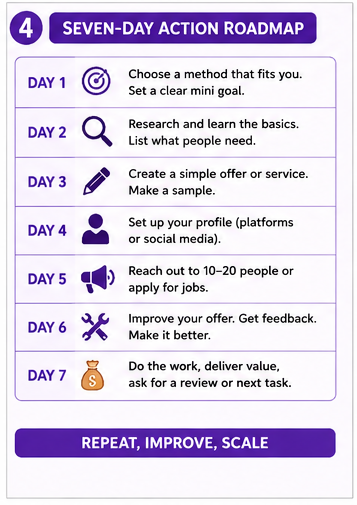
A Seven-Day Plan to Start Earning Online
Many people search how to start earning online, but they keep reading for many weeks. No action happen. One video says freelancing. Another person says YouTube. Someone says sell products. Then your mind become full, but your wallet still same.
This seven-day plan is not magic. You may not make first money online in seven days. Maybe you can. Maybe not. The real purpose is finding whether your idea has some life inside it.
Day 1: Select Only One Path
Choose one path for this week.
You can:
- Sell a service
- Apply for an online job
- Sell one small product
- Build content for an audience
Do not start freelancing, blogging, affiliate marketing, YouTube, and online store together. I see many beginners doing this. They open five accounts, make two posts, then feel tired.
One road is enough for seven days.
For faster result, selling a service is usually more practical. You already may know writing, video editing, Excel, teaching, design, coding, bookkeeping, or social media work.
Day 2: Choose One Customer and One Problem
Do not say, “I help everyone.”
Everyone is not a customer.
Choose one clear person. Maybe a local shop owner, fitness coach, YouTuber, blogger, student, real estate agent, or small company.
Now write three problems they may already pay money to solve.
Example:
| Customer | Problem |
|---|---|
| Fitness coach | No time to edit videos |
| Local shop | Poor Google Business profile |
| Blogger | Old articles getting no traffic |
A good beginner online income plan starts from a real problem, not from your favorite tool.
Day 3: Make One Small Offer
Your offer must be easy to understand.
Bad offer:
“I provide digital marketing solutions.”
People may not know what you will actually do.
Better offer:
“I will turn one webinar into five edited short videos within three days.”
This offer tells the work, quantity, and delivery time. Small offers feel less risky for a new buyer.
Day 4: Create Some Proof
No client yet? Still you can create proof.
Make one sample. Redesign a public page. Edit a practice video. Write a sample article. Build a small demo. Show before and after.
Your proof can be:
- Sample
- Short audit
- Prototype
- Mini case study
- Demonstration
- Before-and-after result
Do not fake client names or results. Practice work is fine. Just call it a sample.
Day 5: Build One Simple Sales Page
You do not need a big website.
Create one page showing:
- Who you help
- What problem you solve
- Your sample
- What the buyer receives
- Price or starting price
- How to contact you
It can be a Google Doc, LinkedIn post, marketplace profile, Notion page, or one-page portfolio.
Simple and clear often work better than pretty and confusing.
Day 6: Contact Real Buyers
Now this part feels uncomfortable. Still, this is where earning starts.
Send ten personal messages. Apply to five closely matching jobs. Ask two friends or old contacts for an introduction.
Do not write, “Dear sir, I am expert, please give work.”
Mention one thing you noticed. Then offer one useful result.
Generic spam gets ignored because it looks same like hundred other messages.
Day 7: Read the Market Signals
Track what happened.
- Messages sent
- Replies
- Profile visits
- Interviews
- Questions
- Objections
- Clicks
- Sales
- Rejections
No reply does not always mean your skill is bad. Maybe customer was wrong. Maybe offer was unclear. Maybe sample looked weak. Maybe message sounded copied.
The goal is not guaranteed income in seven days. The goal is evidence.
You are testing whether people care, understand your offer, accept the price, and respond to your selling method. That knowledge helps you improve. Then week two becomes less blind, and your first online earning becomes more possible.
How to Turn Your First Online Payment Into Reliable Income
Your first online payment feels big. Even it is only ₹500 or $10, you may look at screen many times. Money came from internet. A real person trusted your work. This is good moment, but not yet a business.
Now your next job is simple: make it happen again.
Your First 30 Days
During first month, try to send 100 targeted applications or outreach messages. Do not send same copy message everywhere. Read client problem. Change few lines. Show how your work can help them.
Also improve one portfolio sample. One strong sample is more useful than ten weak works.
Try to get these things before day 30:
- One honest client testimonial
- A list of questions and objections clients give
- A smaller and clearer service offer
- A delivery checklist
- A simple income and expense record
Track net income, not only revenue. You may earn ₹10,000, but tools, ads, internet, platform fees and other costs can eat ₹3,000. Your real earning is ₹7,000.
I learned this late. Big payment looked exciting, but after checking all cost, profit was not so big.
Days 31 to 90
Now you have some proof. This is time to improve, not start ten new things.
Raise your price slowly after you deliver good results. Ask happy clients for monthly work. A one-time social media design job can become 12 posts every month. A website audit can become monthly SEO support.
Do not depend only on Fiverr, Upwork or one job site. Try another way too:
- LinkedIn outreach
- Referrals
- Your own website
- Helpful posts answering customer problems
Save some money for tax, tools and slow months. Online income is not same every month.
Make the Work Easier to Repeat
Turn your service into a fixed package. Pick one type of customer or one painful problem. Make templates for emails, reports and delivery.
Use automation for boring work, but check quality yourself. Do not hand work to another person before your steps are written clearly.
Reliable online income comes slowly. One client, then repeat client, then referrals. This path looks small at first. But small system can grow strong.
Online Earning Mistakes That Waste Time and Money
Many people start online earning with big hope. Then after ten days, they feel tired. Nothing coming. No client, no sale, no reply. Most time, problem is not the internet. Problem is how we start.
First mistake, trying five methods together. Today freelancing. Tomorrow YouTube. Next day affiliate marketing. Your mind become full, but your work remain half. Pick one method. Stay with it for at least few weeks.
Another big mistake is learning forever. Watching video after video feels like progress, but it is not selling. I also saw people learning logo design for months, but never showing one sample to a real shop owner. You need practice, yes. But you also need market feedback.
Do not sell broad skill like, “I do digital marketing.” It tells nothing. Say what result you give. Example: “I help local clinics get more appointment calls through Google Business Profile.” Clear offer get better reply.
Some make product first, then search buyer later. This can waste weeks. Ask people what they need before creating it. Check reviews, forums, comments, and real complaints.
Also, do not trust big income screenshots. You do not know their ad cost, team cost, refund, or old audience. Revenue is not profit.
So, learn everyday money math calculations that gives full clarity to assess your monthly earnings and spends.
Other make money online mistakes are:
- Charging very low price to win every client
- Working without contract or payment milestone
- Buying costly course before testing the skill
- Posting raw AI writing without checking facts
- Depending only on one platform
- Quitting after five ignored proposals
Why online side hustles fail? Often because people want quick proof. Online work need patience, but not blind patience. Track replies, cost, time, and profit. Change weak offer. Improve sample. Send better proposal.
Do not chase easy work only. Easy work usually have too many people. Find useful work. Useful work gets paid.
Which Online Income Method Should You Choose?
There is no one best way to earn money online. Your best method depend on your time, skill, money need, and patience.
You may see people saying, “Start YouTube,” “Sell products,” or “Do freelancing.” But their life is not your life. Some person can wait one year for income. You may need money this month. So choose with your real condition, not internet excitement.
Choose freelancing or online tutoring when you already know something useful. Writing, design, video editing, coding, maths, English, or even Excel. This path can give money faster, but you must speak with clients. Rejection will come. Sometimes no reply also. Keep improving your offer.
A remote job is better when you need steady monthly income. You get work hours, team, and fixed duties. Less freedom maybe, but more stable.
Choose digital products or ecommerce when you enjoy making and selling things. Income may start slow. Your first product may not sell. That failure can teach what buyers actually need.
Choose content creation or affiliate marketing only when you can keep publishing for many months. Trust takes time. People rarely buy from a new voice quickly.
Use microtasks and surveys only for small extra money. Never treat them like full career. Check platform before giving your ID or bank details.
Pick one method today. Make one offer, product, video, or job application. Then wait for one real market answer before watching another tutorial.
Frequently Asked Questions About Earning Money Online
1. What is the best way to earn money online for beginners?
For most beginners, selling one simple service is a good start. You may try writing, video editing, tutoring, virtual assistant work, or social media help. Pick something you can learn fast. Make two samples, then show them to real people who may need that work.
2. How can I earn money online without investment?
You can start freelancing, tutoring, remote work, or content services with free tools. A phone and internet may be enough for starting. But “without investment” does not mean without effort. Your time, learning, practice, and patience are also investments. Never pay money just to receive a job.
3. What is the fastest legitimate way to make money online?
The fastest path is usually selling a skill you already have. A person may pay you for editing a video, making a poster, fixing a resume, teaching a subject, or managing social pages. Building a blog or YouTube channel takes more time. Service work may bring payment sooner.
4. Can I earn money online using only a phone?
Yes, but your choices will be smaller. You may manage social media, edit short videos, tutor students, sell products, write captions, or create user-made brand videos. For bigger work like coding, long writing, design, and data tasks, a laptop makes the work easier and more professional.
5. How can students earn money online?
Students can tutor younger learners, edit videos, design simple posts, write notes, translate text, manage social pages, or help local shops online. Start with one small job. Do not leave studies for quick money promises. Good skill and good education can grow together, not fight each other.
6. How can I make money online with no experience?
Create your own experience first. Make sample work even when no client is there. Write a sample article, edit a public video, design a fake shop poster, or build a small website. These samples become your proof. A client wants to see what you can do, not only certificates.
7. Can I earn money online using AI?
Yes. AI can help with research, ideas, subtitles, email drafts, design support, reports, and work automation. But raw AI output is often weak or wrong. Check facts. Improve the work with your own mind. Clients pay for a useful result, not because you pressed one AI button.
8. Is freelancing better than affiliate marketing?
Freelancing may be better when you need money sooner. You directly work for a client and receive payment. Affiliate marketing can grow bigger later, but it needs traffic, useful content, and trust. One is active income. The other may take months before a first useful commission comes.
9. How long does it take to earn the first payment?
Some people earn in a few days. Many take several weeks or months. It depends on your skill, offer, price, samples, and how many people you contact. Do not only wait on a freelance website. Apply for jobs, ask local businesses, use LinkedIn, and speak with your network.
10. Can I make ₹1,000 per day online?
Yes, it is possible, but not promised. A tutor, designer, editor, writer, developer, or seller may earn ₹1,000 or more on some days. First focus on one paying customer. Then improve quality, raise price slowly, and get repeat work. Daily income may not stay equal every day.
11. Are paid surveys worth it?
Paid surveys may give small pocket money. They normally cannot replace a job. Many surveys reject users after asking several questions, which feels very bad. Use only known research platforms. Never pay registration fees. Surveys are okay for spare time, but poor choice for long-term income.
12. Which online jobs are scams?
Be careful with typing jobs, task jobs, product-rating jobs, reshipping work, and offers promising fixed daily profit. A common scam asks you to deposit money before withdrawing earnings. Real employers normally do not ask you to pay for work. Check the company website and official email address.
13. Do I need a website to earn online?
No. You can begin through freelance platforms, LinkedIn, social media, marketplaces, or direct messages. A website becomes useful later. It can show your samples, services, reviews, and contact details in one place. Begin with a simple portfolio page. Do not delay earning for a perfect website.
14. How do I receive international payments?
Freelance marketplaces may handle payments for you. Direct clients may use bank transfer or international payment services available in your country. Check conversion fees, withdrawal charges, payment time, invoice rules, and account verification. Keep payment details private. Do not accept strange overpayments or return-money requests.
15. Do I have to pay tax on online income?
Online income may be taxable depending on your country, income level, and type of work. Keep invoices, payment records, platform statements, and expense bills. Do not wait until year end and then search everything. For personal tax advice, speak with a qualified tax professional in your region.
16. What is the safest online earning method?
A verified remote job or trusted client work with written payment terms is usually safer. Use secure platforms, milestone payments, contracts, and clear work details. Still, no method is fully risk-free. Check the buyer, protect personal documents, and never send money to unlock salary or commission.
17. Can online income replace a full-time salary?
It can, but usually not very fast. First your online income may be irregular. Try replacing one small monthly expense before leaving a job. Build repeat clients, emergency savings, and stable demand. Leaving too early can create fear, and fear may make you accept poor clients or scams.
18. What skill should I learn to earn money online?
Learn a skill connected to a real problem. Good options include sales, writing, video editing, design, coding, bookkeeping, tutoring, data work, customer support, and AI automation. Choose one you can practice for months. The best skill is useful, sellable, and not painful for you to continue.



2 comments