
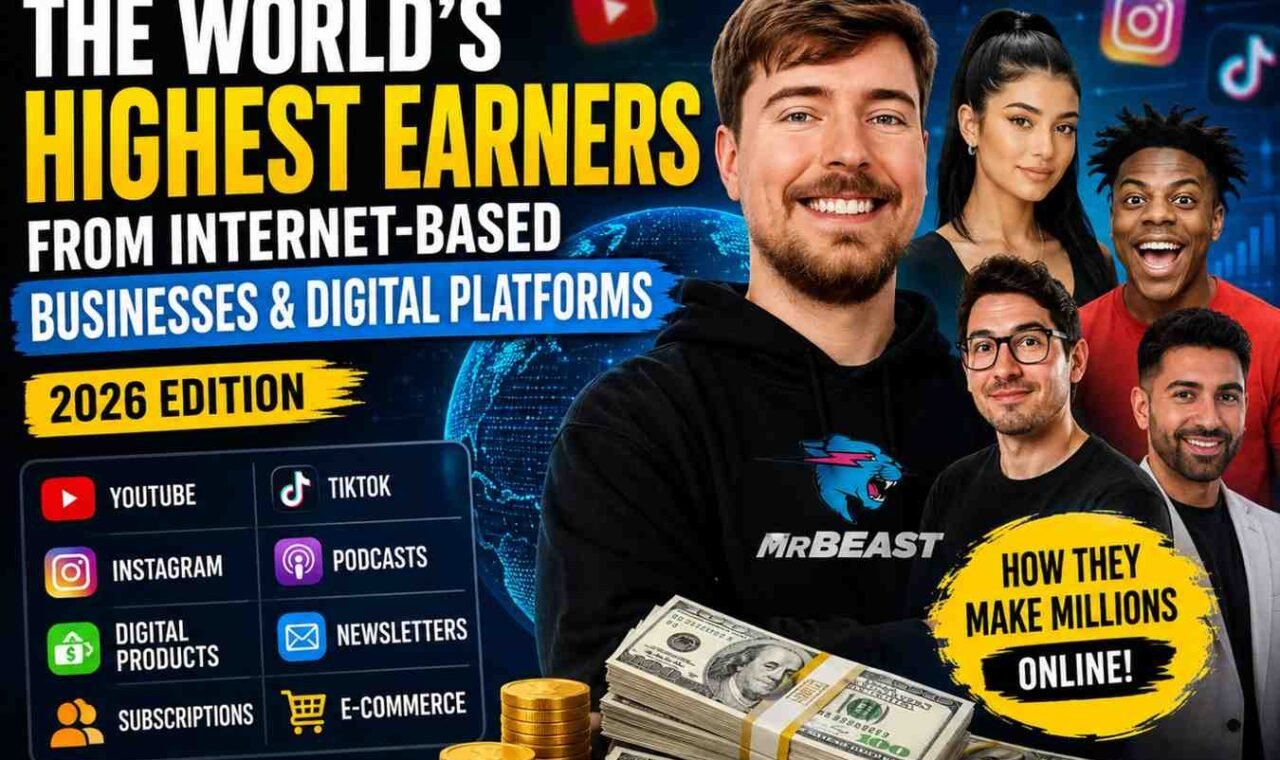
MrBeast is sitting at the top in 2026. Forbes, on June 23, 2026, estimated his yearly earnings at $300 million. Dhar Mann comes far behind at about $65 million. Big gap. Very big actually.
But here one confusion comes. Highest-paid does not always mean richest.
Earnings, company revenue, profit and net worth are different money numbers. I see many online lists mixing all these together, and then numbers look crazy. A creator may run a $100 million business, but that money is not fully going into his pocket.
Internet-based business also means much more than YouTube ads now. We are talking YouTube, TikTok, Instagram, podcasts, newsletters, streaming, affiliate marketing, online courses, paid subscriptions, software, digital products and creator-owned brands.
And followers? Don’t trust that number alone.
Someone with smaller audience but strong buyers can earn more than a person having millions of casual followers.
The world’s highest internet earners no longer depend only on views. They build audience, products, sponsorships, subscriptions, licensing, IP and their own companies.
That is why this ranking can change every year. Our figures here use data checked through August 11, 2026.
By inspiring from these people learn how to make Money online?
2. The 2026 Internet-Earner Leaderboard
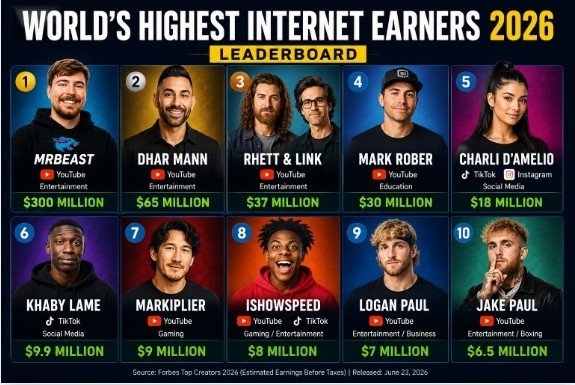
When I first look at these numbers, $300 million almost looks wrong. Too big. But Forbes put MrBeast at No. 1 in its June 23, 2026 Top Creators ranking, with estimated earnings of $300 million. Dhar Mann came second at $65 million.
| Rank | Person | Main Platform | Business/Niche | 2026 Est. Earnings* | Main Money Sources |
|---|---|---|---|---|---|
| 1 | MrBeast | YouTube | Entertainment, commerce | $300M | Media, products, brands |
| 2 | Dhar Mann | YouTube | Digital entertainment | $65M | Studio, ads, media deals |
| 3 | Steven Bartlett | Podcast/Social | Business media | $52M | Podcast, events, investments |
| 4 | Markiplier | YouTube | Gaming, film | $38M | Content, film, podcasts |
| 5 | Rhett & Link | YouTube | Entertainment | $37M | Shows, media, products |
| 6 | Charli D’Amelio | TikTok | Lifestyle | $18M | Brand deals, entertainment |
| 7 | Druski | Social media | Comedy | $20M | Content, commercials |
| 8 | IShowSpeed | YouTube | Gaming, sports | $30M | Content, brand deals |
| 9 | Mark Rober | YouTube | Science | $30M | Videos, sponsors, CrunchLabs |
| 10 | Codie Sanchez | Social media | Business education | $31M | Media, business ventures |
Forbes’ ranking order is not simply highest dollars first; its methodology also considers creator influence and entrepreneurship. The earnings figures above are Forbes estimates.
And this is where people easily get confused.
Estimated earnings ≠ company revenue ≠ profit ≠ net worth.
I saw this clearly with MrBeast. His Forbes estimate stayed at $85 million in both 2024 and 2025, then jumped to $300 million for 2026. Dhar Mann moved from $45 million in 2024 → $56 million in 2025 → $65 million in 2026.
The bigger lesson? Internet money is not only YouTube ads now. Podcasts, TikTok influence, streaming, subscriptions, physical products, education, licensing and creator-owned companies are sitting in the same money race. Your audience may start on one platform. The big earners usually don’t stop there.
MrBeast: From YouTube Channel to Internet Business Empire
MrBeast is not just making YouTube videos now. That thinking became old.
Jimmy Donaldson built something much bigger.
Forbes ranked him No. 1 creator in 2026, estimating his annual earnings at $300 million. Forbes also says his YouTube channels have more than 640 million subscribers combined and get over 5 billion views a year. These are Forbes estimates, not his personal bank records.
But here is interesting part.
YouTube ads alone did not build this empire.
Years back, Forbes reported that $32 million of his $54 million earnings came from ads and about $9 million from sponsored content. Today his money machine looks much wider.
Content → Audience → Viral distribution → Sponsorship → Products → Company → Global brand
Beast Industries now connects media with businesses such as Feastables, Lunchly, Viewstats, toys and licensing.
And chocolate tells a strange story.
Investor documents reported by business publications showed Feastables producing about $250 million in 2024 sales and more than $20 million profit. During roughly same period, the media side produced similar sales but lost almost $80 million.
That part made me look twice.
A video may bring huge views, yet making that video also costs crazy money. Sets. Staff. Prizes. Travel. Editing. Ideas that fail.
Jimmy keeps putting money back into bigger projects. So immediate profit can stay thin while audience become bigger.
That is the lesson I would take.
Don’t copy his $1 million challenge. You probably cannot.
Copy the system.
Make useful or exciting content. Earn attention. Build trust. Then move that attention toward something you own—email list, product, service, software, membership or brand.
MrBeast’s real advantage is not only AdSense.
YouTube brings the people. The business begins after people arrive.
Five Different Ways Top Internet Earners Built Their Fortunes
Big internet money not come from one road. I notice this when looking these creators. Same internet, same YouTube or TikTok screen, but business behind screen is very different.
Dhar Mann — Build content like a factory
Dhar Mann found one story format people keep watching: simple drama, problem, emotion, lesson. Then he scaled it. In 2026, Forbes says his team has about 200 people, his content reaches nearly 300 million views in a normal week, and videos get translated into 13 languages. Forbes estimated his 2026 creator earnings at $65 million.
What worked? Repeatable storytelling.
But here is problem. You cannot copy this tomorrow from bedroom. Actors, studio, writers, editing, payroll. Big machine need big cost.
Lesson: First make one format work. Scale later.
Rhett & Link — Don’t build only a channel
Good Mythical Morning became something larger: Mythical Entertainment. They make about 240 GMM episodes each year, plus Mythical Kitchen, memberships, products and other shows. Forbes estimated $37 million earnings for 2026.
This is interesting to me. One show brought attention. But they didn’t leave money sitting only inside YouTube ads.
Lesson: Your successful content can become a media company.
Mark Rober — Teach first, sell something connected
Mark Rober’s science videos built trust. Then CrunchLabs turned that trust into STEM subscription kits. Forbes estimates his 2026 earnings at $30 million; his team has about 100 people.
That connection matters. Science video → curious child → science kit. It feels natural, not random selling.
Charli D’Amelio — Attention can open other doors
TikTok dancing gave Charli massive reach. But income moved beyond TikTok payouts into Prada, Kate Spade and wider entertainment work. Forbes estimated $18 million earnings in 2026.
Lesson: Platform fame is useful. Depending only on platform payment is weak.
Khaby Lame — Make content that crosses borders
Khaby became huge with almost no spoken language. Facial reaction, gesture, joke. Easy to understand anywhere. Forbes lists 252.1 million total followers and estimated $9.9 million 2026 earnings, with deals including Hugo Boss and other global brands.
His limitation also teaches us: huge followers does not always mean highest income.
Five people. Five systems.
The deeper pattern is same: attention brings people, but business model decides money.
Where the Money Really Comes From
Many people see one creator getting 10 million views and think, “Ah, YouTube ads made him rich.” Not always. Sometimes ads only one pipe. The bigger money sits behind the audience.
YouTube itself says creators in its Partner Program can earn from advertising and other monetization features. But smart creators normally don’t stop there.
I look at creator income like this:
| Money source | How it comes |
|---|---|
| Platform | YouTube ads, TikTok or streaming payouts |
| Advertising | Sponsors, brand deals, integrations |
| Commerce | Merch, food, beauty, physical products |
| Knowledge | Courses, coaching, consulting |
| Digital assets | Ebooks, templates, software, tools |
| Recurring | Newsletter, membership, community |
| Performance | Affiliate commission |
| Media/IP | Licensing, formats, characters, syndication |
| Company | SaaS or creator-owned brands |
Affiliate income is different from sponsorship. Brand may pay you once for a sponsored video. Affiliate pays when your reader or viewer actually buys. Impact describes affiliate marketing as performance-based: partners earn commission for producing a defined result.
Subscriptions behave different again.
One sponsor can disappear next month. One ebook buyer may never buy again. But 1,000 people paying every month creates another kind of business. Patreon calls paid memberships a source of recurring income, while Substack says recurring subscription revenue can be steadier than selling one-off content.
Still, subscriptions need constant value. People cancel when value feels gone.
Digital products have another beauty. Build one useful template, ebook, course or tool, then sell it many times. But I would not build first and pray people buy. Find their problem first. Ask them. Sell small version. Then improve.
That is why top internet businesses slowly move like this:
Views → Audience → Customers → Recurring Revenue → Intellectual Property
Views bring attention. Audience gives trust. Customers bring money. Recurring revenue gives some stability. And IP—your brand, software, product, format or character—can become the asset that keeps earning even when one viral post dies.
Platform Economics: Where Can Creators Make the Most?
I used to think the platform with most views must give most money. Not always. After watching creators move from TikTok to YouTube, then push people into email lists, one thing become clear: reach and income are not same thing.
| Platform | Discovery | Money Potential | Audience Control | Recurring Income | Risk |
|---|---|---|---|---|---|
| YouTube | High | High | Low | Medium | Medium |
| TikTok | Very high | Changes a lot | Low | Low | High |
| High | Mostly brand deals | Low | Low | High | |
| Newsletter | Lower | High | High | Very high | Lower |
| Patreon | Depends on your audience | High | Medium | High | Medium |
| Podcast | Medium | High at scale | Medium | High | Medium |
| Blog/SEO | Search based | Many ways | High | Medium | Search risk |
YouTube still feel strong because one video may keep getting search and suggested traffic long after upload. Its Partner Program supports ad revenue and other earning tools such as fan funding and Shopping for eligible creators.
TikTok can push unknown creator very fast. That is exciting. But fast views don’t mean stable business. TikTok now uses its Creator Rewards Program instead of the old Creator Fund, and rewards depend on qualifying original content and other conditions.
Instagram works well when your face, niche and brand trust are strong. But I would not keep whole business there. Same with TikTok. You don’t really own that follower connection.
This is where newsletters feel different.
A person may have only 5,000 email subscribers and still build better income than someone having 100,000 loose social followers. Substack itself tracks paid subscribers, subscription growth and revenue sources.
Patreon goes even more direct. Monthly and yearly memberships can make recurring income, although platform and payment fees reduce what finally reaches creator.
For me, YouTube vs TikTok, blogging vs YouTube, newsletter vs blog, SEO vs social is wrong question sometimes.
Use social for discovery. Use search for lasting traffic. Pay for traffic only when numbers make sense. Then move interested people toward something you control.
Platforms give you reach. Your website and email audience give you resilience.
The Small-Audience Paradox: More Followers Doesn’t Always Mean More Money
Can someone having 10,000 followers earn more than one person with 1 million followers?
Yes. And this thing confuse many people.
I used to look at follower number first when seeing online creators. Big number looks powerful. But business not always work like that. What matters is, who is listening and why they follow you.
Think simple.
| Audience | Possible business |
|---|---|
| 1,000 useful niche followers | Consulting or service |
| 10,000 niche subscribers | Courses, templates, digital products |
| 1,000 paying members | Recurring monthly income |
| 1M entertainment followers | Huge reach, but buying intent may be weak |
A software expert with 10,000 right people may sell a $200 product easier than an entertainment page selling something random.
That is where revenue per follower becomes useful.
You also need watch conversion rate, average revenue per customer, customer acquisition cost (CAC), lifetime value (LTV), and how many people actually open your emails.
Email matters because you can contact that audience again. You are not waiting only for algorithm.
Kevin Kelly explained this idea back in 2008 with “1,000 True Fans”—you may not need millions of people, but enough real supporters who repeatedly buy your work.
This is why small B2B, finance, software, and specialist education audiences can become surprisingly valuable.
Follower count show attention.
Buying intent shows business.
Newsletters, Podcasts, Patreon & Recurring Revenue
Big audience looks nice. Money does not always care.
I noticed this especially with newsletters. A writer may have only 2,000 people who really read his mails, trust him, and sometimes buy. Another person got 50,000 social followers, but most just scroll and go. So which audience is better? Many times, first one.
Because intent + conversion + retention can beat raw reach.
Substack shows this idea well. Its Top Bestseller leaderboard ranks publications by annual recurring revenue, and Substack says this list updates daily. Its Rising list looks at paid subscriber growth. So free subscribers are useful, yes, but moving some of them into paid readers is where business starts becoming stable.
That conversion is hard. I would not depend only on Substack discovery. Writers bring readers from LinkedIn, Reddit, YouTube, search, even their own old contacts. B2B newsletters can be more interesting here. One good reader may later become a consulting client, software buyer, or paid member.
Patreon works similar way. Membership gives recurring money, but dashboard money is not same as clean profit. Patreon says fees, refunds, declined payments and other deductions affect final net earnings.
Podcast money gets wider: ads, paid subscriptions, merchandise, licensing and network deals.
Alex Cooper is a strong example. In August 2024, her Call Her Daddy business signed a multiyear SiriusXM deal reportedly worth up to $125 million, covering advertising and distribution rights around her shows and Unwell Network.
That is the point I keep seeing.
Virality may bring people.
Recurring revenue gives you something closer to a business.
The Numbers Creators Rarely Show
A creator says, “I make $1 million a month.” Big number. Sounds rich.
But I learned not to stop there.
That $1 million may be revenue, not money sitting in the creator’s bank. From it goes video production, employees, editors, freelancers, software, ads, platform charges, refunds and taxes. What remains can look very different.
Think like this:
Revenue – production – employees – contractors – software – marketing – platform fees – refunds – taxes = real business outcome.
And these words get mixed badly online.
Revenue is money the business brings in. Gross income is income before many costs. Profit is what remains after expenses. Creator earnings means money credited or estimated for the creator. Company revenue belongs to the business, not automatically its founder. Net worth is estimated value of owned assets minus debts. Company valuation is what a company may be worth. GMV is total value of goods sold through a system. Contract value can cover several years. Platform payout is what finally gets paid after platform rules and deductions.
YouTube itself says estimated monthly revenue can change because of invalid traffic, Content ID claims and other adjustments. Finalized earnings may therefore differ from the number first shown inside analytics. Patreon also deducts platform, payment-processing and sometimes currency or payout fees.
This is why I never judge a creator by headline revenue alone.
Some months ads pay better. Other months fall. Then comes a costly product launch, staff salary or huge reinvestment.
So if your creator business grows, keep cash reserve. Forecast weak months too.
Millions coming in can look exciting.
Profit tells the quieter story.
What Goes Wrong: Real Creator Failure Patterns
We see millionaire creators. Big views. Big houses. Huge numbers. But we rarely see what happened before that. Or how many people tried same thing and disappeared.
That part matters.
I have noticed one dangerous mistake again and again — depending on one traffic source. A blogger may get 80% of visits from Google. A YouTuber depends fully on recommendations. Then one change comes. Traffic falls. Google itself says core updates can cause ranking changes, and recommends checking affected pages and queries rather than assuming one simple problem.
YouTube has another pain. Demonetization.
You may still have subscribers and views, yet income can get hit when a channel breaks monetization rules. YouTube says invalid traffic, fake engagement, Content ID problems and policy violations can affect monetization. Severe violations may even disable it.
Then comes a more painful lesson.
Followers are not customers.
You got 100,000 followers. You launch a T-shirt. Almost nobody buys.
Why?
Maybe people came for funny videos, not shirts. Same happens with courses, paid communities and newsletters. Audience was there, but buying reason was weak.
I would test before building big:
- Ask readers what problem hurts them.
- Make a small offer first.
- Watch clicks, replies and actual sales.
- Build more only when buyers show interest.
Another creator trap is viral-without-business. Millions watch you today. Tomorrow they forget you. No email list. No product. No customer relationship.
Newsletter creators face this too. Substack itself tracks where new subscribers come from, including search, recommendations and other publications. That tells us one thing clearly: growth needs more than just publishing and hoping.
And then burnout comes.
More videos. More posts. More sponsors. More pressure.
At some point your audience may feel every post is selling something.
So don’t only ask, “How can I grow faster?”
Ask this also:
If my biggest traffic or income source vanished tomorrow, what would still remain?
That question may save your whole creator business.
11. How Successful Creators Recover
Creator business can fall very fast. I seen this many times. One month views coming good, next month algorithm change and traffic look almost dead. This is why depending on one platform is scary.
When algorithm traffic drops, first thing I would do is not post more in panic. I check where audience still coming from. Then build other doors—Google search, email list, YouTube, Instagram, maybe podcast. Patreon also calls this distribution diversification, meaning your work should not depend on one algorithm only.
Demonetization is another hard hit. YouTube says monetization can be removed for policy problems, invalid traffic, fake engagement, or content issues. So, ads cannot be your whole salary. Products, paid memberships, sponsors, consulting, affiliate income—these become backup legs.
A failed product launch hurts more personal. You made it. Nobody buying. I would stop guessing here. Talk with users. Ask what they wanted, what price felt wrong, then test a small offer or pre-sell before building again.
Newsletter stopped growing? Find readers outside newsletter platform. Burnout? Batch work, make simple systems, give editing or admin work to another person.
Trust damage is different. No clever marketing fixes it. Say what went wrong. Refund when needed. Solve customer problem first.
I call recovery the Four Diversifications:
Distribution diversification + Audience diversification + Revenue diversification + Platform diversification.
That matters because even creator agents now openly push direct audience relationships such as newsletters alongside large social platforms.
You cannot stop every platform change. But you can stop one change from killing your whole business.
Can AI Build the Next Million-Dollar Creator Business?
Yes, you can make money with AI undoubtedly.
AI can help you build faster. But it cannot fix a bad idea.
I use AI little like extra worker. Researching topics, finding missed questions, cutting long video into short clips, checking comments, making first edit, answering common customer doubts. It saves hours. That part is real.
But then people see videos saying “Make $10K a month with AI, no face, no work.” Here I become careful. Tool is easy. Business is not.
Can AI-generated YouTube content monetize? Yes, possible. YouTube says AI use itself does not automatically stop monetization. But content still need to follow monetization rules.
Faceless channel also can work. Your face is not the important thing. Original value is.
Problem starts when videos become factory stuff—same template, same voice, same images, tiny changes, hundreds of uploads. YouTube now calls this “inauthentic content.” Mass-produced or repetitive content can be ineligible for monetization.
Reused content is another trap. Taking clips already online and adding little change may not be enough. You need meaningful commentary, story, teaching, editing, or some clear new value.
There is also copyright headache. AI does not magically give permission for music, video, voice, face, or other people’s work. Realistic altered or synthetic content may also need disclosure on YouTube.
So I see AI this way:
AI as production leverage = useful.
AI as automatic low-value content factory = risky.
Use machine for speed. Keep your judgment, experience, mistakes, opinions and useful human work inside the final piece. That is where real creator business start.
A Practical Internet-Business Blueprint for Beginners
Looking at million-dollar creators is exciting. But I feel copying their business today is wrong place to start. Your first target may be only $100. That small payment teaches more than watching another 50 success videos.
1. Find one painful problem.
Go where your people already asking questions. Google, Reddit, YouTube comments, Facebook groups. I would look for same question appearing again and again. That repeated pain can become business.
2. Choose one traffic road.
YouTube, blogging/SEO, newsletter, podcast, Instagram. Not all five. Trying everything normally makes beginner tired before anything grows.
3. Give useful proof first.
Show how you solved something. Screenshots, process, mistake, result, small case study. Google itself says its systems aim to reward helpful, reliable content made for people, not mainly for manipulating rankings.
4. Don’t leave your audience rented.
Social followers belong inside somebody else’s platform. Move interested people into email list, website or customer database. Substack, for example, says writers keep 90% of subscription revenue before card fees and can own their subscriber list.
Then money can move slowly:
| Stage | What I would try |
|---|---|
| First $100 | Small service or affiliate sale |
| $1K/month | Repeat useful offer |
| $10K/month | Product + audience + system |
| $100K/year | Recurring sales and team |
Before building course, app, or big product, talk with real users. Make waitlist. Sell small MVP. Get feedback. Many months can be saved here.
Later add course, template, software, membership or commerce. Build recurring income. Write your working process down, then hire when work become repeated.
And diversification? Not too early.
First make one small engine work. Then build second engine beside it.
What You Should—and Shouldn’t—Copy From Top Earners
I used to look at big creators and think, maybe their posting style is the secret. Wrong place to look.
Don’t copy MrBeast-size budgets, another creator’s niche, their upload timing, huge team, viral thumbnail style, or costly product launch. Their road was built for their audience, money, skill and timing. Yours is not same.
What you can copy is the thinking behind it.
Start here:
Audience → Problem → Distribution → Offer → Conversion → Retention → Economics → Moat
First know your audience. What problem keep coming again? Make content around that. Test small. See what people click, reply, buy, leave, or ignore.
Keep your email audience too. Substack, for example, allows publishers to export subscriber lists, showing why owned audience can matter when platform reach changes.
And don’t fear changing things. YouTube itself puts importance on original, authentic content rather than mass-made repeating work.
I would copy consistency, customer feedback, reinvestment, systems and useful products.
Not their surface.
Copy why it worked, not only what it looked like.
How We Verified These Earnings
Money numbers online can fool you fast. I learned not to trust one article, one screenshot, or a creator saying, “I made millions.”
So we checked from top to bottom.
Level 1: Company filings and official platform documents.
Level 2: Direct creator interviews and public statements.
Level 3: Forbes and trusted financial reporting.
Level 4: Industry data and analytics estimates.
Level 5: Creator income claims. We mark these as self-reported.
Forbes says its 2026 Top Creators list estimated gross earnings from March 1, 2025 to March 1, 2026, and did not count equity held in companies.
Still, some numbers stay cloudy. Many creator businesses are private companies. Full financial records may not be public, so nobody outside can always verify every dollar.
One rule mattered most to me: never mix earnings, business revenue, profit and net worth. They are not same money.
Research completed: August 11, 2026
Last updated: August 11, 2026
Financial period: Latest available reporting period; Forbes ranking uses March 2025–March 2026
Currency: USD
Method: Official records first, then interviews, trusted reporting, industry estimates, and clearly marked creator claims.
The Bigger Lesson: Attention Isn’t the Business
Getting views feel big. I know. One video moves fast, followers come, numbers jump. You may think, “Now business started.” Not always.
Attention is only first door.
A better path looks like this:
Attention → Trust → Owned audience → Offer → Customer → Recurring revenue → Brand/IP → Company
The hard part is moving people from one step to next.
Platforms can give you reach today and less reach tomorrow. Algorithm change, account issue, audience mood, all can hit. So I would not keep whole future inside YouTube, TikTok, Instagram, or any one place.
Move some people to email. Build trust slowly. Sell something useful, not random stuff. See what customers buy again. Fix what they complain about.
That is where internet-based businesses become stronger.
Fame can disappear fast. But customer trust, email list, useful product, brand name, and owned IP stays more in your hands.
That is the real business.
People Also Ask About the World’s Highest Internet Earners
Who is the world’s highest-paid internet creator in 2026?
MrBeast, real name Jimmy Donaldson. Forbes ranked him No. 1 in June 2026 with estimated earnings of $300 million and 873 million followers across platforms.
How much does MrBeast earn?
Forbes estimates $300 million for its 2026 ranking. But this is estimated earnings, not his personal net worth or total company revenue.
Who are the richest YouTubers?
MrBeast leads by a very large gap. Dhar Mann, Markiplier, Rhett & Link, IShowSpeed and Mark Rober are also among major 2026 creator earners.
Which social-media platform pays creators most?
There is no fixed winner. YouTube is strong because creators can mix ads, memberships, shopping and other income. YouTube says creators receive 55% of long-form ad revenue and 45% of Shorts allocated revenue.
Can you make $100,000 without millions of followers?
Yes. A small audience can work if people actually buy your service, course, membership or product.
How many followers you need to make money?
No magic number. Buying intent matters more than follower count.
What creator model makes most profit?
Usually owned digital products, software, memberships and services can give strong margins. But costs change everything.
Is newsletter more profitable than YouTube?
Sometimes. Newsletter has smaller reach, but paid readers can give recurring income.
Can AI-generated content make money?
Yes, AI use itself is not banned. YouTube still expects original, authentic content and requires disclosure for realistic synthetic media.
What percentage of creators earn full-time income?
There is no single reliable worldwide percentage. Earnings are very uneven, and research shows money gets heavily concentrated among top creators.
