
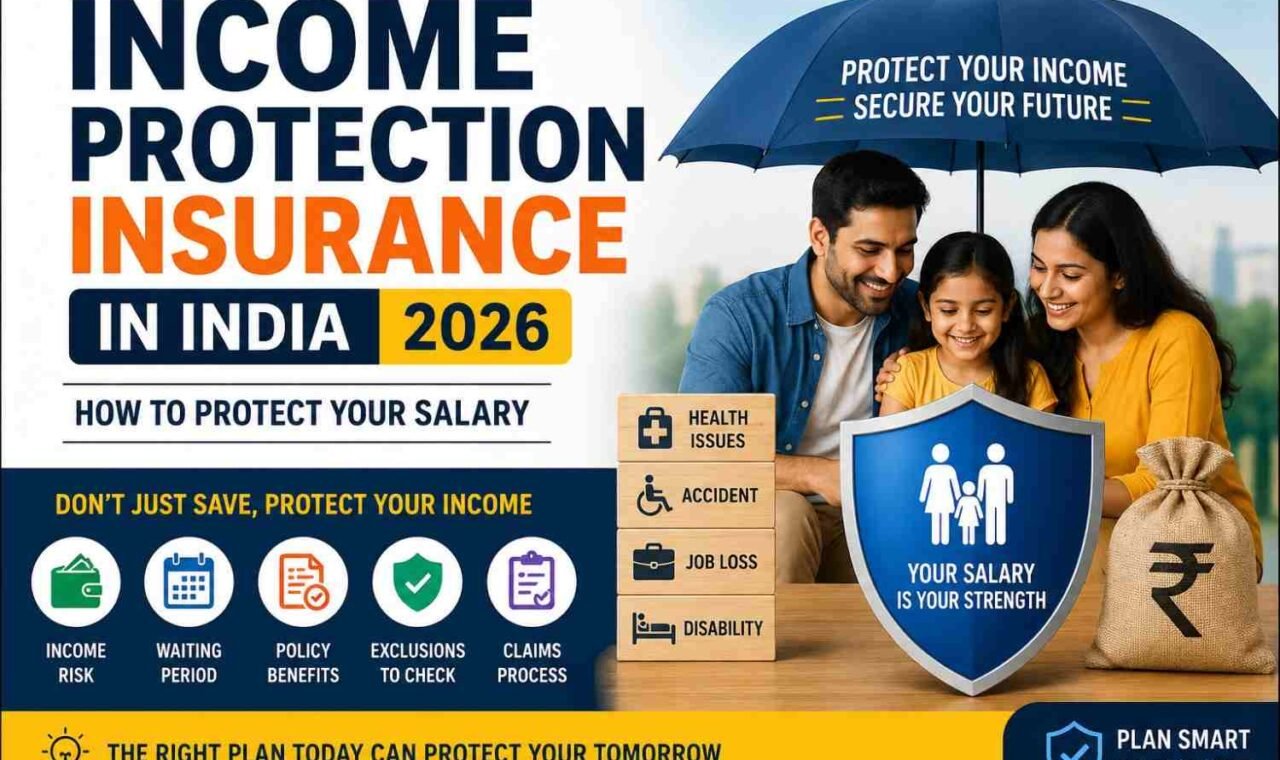
Is income protection insurance available in India? Yes, but not like one simple policy you may see in UK or Australia. In India, there is no single standard income protection insurance product doing every job. Current Indian insurance guidance also explains it this way.
Your salary can stop for many reason. Accident. Big illness. Disability. Even job loss. One policy may not save all these problems.
I see it better like building small safety walls around your income:
Personal accident/disability benefit + critical illness cover + health insurance + term insurance + hospital cash + employer benefits + emergency savings + limited job-loss/EMI cover.
Some personal accident policies can even include Temporary Total Disability payments when accident stops you working.
So first ask, why can my income stop? Then find cover for that exact risk.
Products and policy information checked: September 2026.
What Does Income Protection Insurance Actually Mean?
Think your salary is ₹1,00,000 every month. Life going normal. EMI paid, food, school fee, other small bills. Then one accident happens. You cannot work for 5 months.
Salary may reduce or stop. But your house still needs ₹60,000 every month. This is the gap income protection insurance tries to solve. In countries where these policies are available, it normally pays part of lost income when illness or injury makes you unable to work. Policy rules decide how much and when payment starts.
I see people mixing all insurance into one bucket. That creates trouble.
| Protection | Mainly protects |
|---|---|
| Health insurance | Medical bills |
| Term insurance | Family after death |
| Critical illness | Listed serious illness |
| Personal accident | Accident disability/death |
| Income protection | Covered loss of earnings |
| Job-loss cover | Certain unemployment events |
So salary protection is not same thing as hospital cover. And income replacement is usually not normal job-loss cover either.
Your real question should be simple: If I cannot earn tomorrow, what exactly will pay my monthly bills?
The First Question: Why Could Your Income Stop?
Before looking for income protection insurance, I think one question should come first. Why your income may stop?
It can happen many ways.
Illness → Accident → Temporary disability → Permanent disability → Critical illness → Hospital stay → Death → Layoff → Business interruption
These look same from home side. Money stops coming. EMI still comes. Food bill also not waiting.
But insurance see these problems differently.
Take Ravi. His company cuts staff and Ravi loses job. Priya still has job, but after an accident she cannot work for six months.
Both people lost income. Still, same policy may not help both.
Normal income protection plans in markets where these policies are common mainly pay when illness or injury makes you unable to work. They usually do not cover redundancy or normal job loss. Job-loss protection can be separate cover with its own rules.
This point I would check before premium, brand name, or fancy benefits.
Ask yourself:
| What stopped income? | What to check |
|---|---|
| Illness | Income/disability cover |
| Accident | Personal accident/disability |
| Critical illness | Critical illness cover |
| Layoff | Job-loss/EMI cover |
| Death | Life insurance |
So don’t start with “best income protection insurance.”
Start with: What event can stop my income, and which policy actually pays for that event?
Step 1 — Calculate How Much Income You Actually Need to Protect
First thing, don’t protect salary just because salary is big.
You earn ₹1 lakh monthly. Sounds like you need ₹1 lakh income protection insurance. Maybe no. I used to think same way. But bills tell different story.
Sit with paper. Open bank app also. See where money really goes.
| Monthly Need | Amount |
|---|---|
| Home-loan EMI | ₹25,000 |
| Food | ₹15,000 |
| Utilities | ₹6,000 |
| Children’s expenses | ₹10,000 |
| Other essentials | ₹9,000 |
| Total | ₹65,000 |
So here, ₹65,000 is the money keeping house moving. Not ₹1 lakh.
Now use this small calculation:
Monthly protection gap = Essential expenses − Reliable alternative income − Existing benefits
Suppose your spouse can safely bring ₹15,000 monthly and employer gives ₹10,000 worth of useful income benefit for some period.
₹65,000 − ₹15,000 − ₹10,000 = ₹40,000 gap.
That number matters.
Current government-backed consumer guidance in Australia also tells people to first make a budget, find monthly expenses, then subtract savings and other income support before deciding how much income protection is needed.
Don’t count bonus, overtime or money somebody may give you. Count reliable money only.
When asking “How much income protection insurance do I need?”, start from bills. Your lifestyle can shrink little. EMI usually won’t.
Step 2 — Check Your Emergency Fund Before Buying More Insurance
Before buying more income protection insurance, I would check one boring thing first. Your bank balance.
Ask yourself: If salary stop next month, how many months can I live normally?
Say your basic home cost is ₹60,000 every month.
₹60,000 × 6 months = ₹3.6 lakh emergency fund.
Now see the difference.
| Savings | What it means |
|---|---|
| 1 month | Very thin safety |
| 3 months | Some breathing room |
| 6 months | Better gap cover |
| 12 months | Much stronger cushion |
This matters because insurance money may not start from day one. Some disability covers use an elimination period before payment begins. SBI General’s current Group Personal Accident Flexi wording, for example, says Temporary Total Disablement benefit starts only after the selected elimination period.
I see emergency fund and insurance as two different tools. Savings handle the waiting days. Insurance may handle the bigger loss later.
So for income protection vs emergency fund, don’t pick only one. Make them work together.
Step 3 — Check What Your Employer Already Gives You
Before paying new premium, I first check one boring place. HR benefits.
Many workers already have some cover but don’t know what exactly there. Paid sick leave may keep salary coming for few days. Group health insurance can pay eligible hospital bills. Some companies also give group personal accident, group life insurance, critical illness benefit, disability support, employee help programs, or some salary continuation.
I once seen people saying, “Company insurance is there, so I am safe.” Not always.
Ask HR these things:
- How many paid sick days I get?
- Is disability income paid?
- What accident benefit available?
- Critical illness lump sum there?
- What happens when I resign or lose job?
Most important, ask for actual group policy wording. Benefits slide or HR email may look nice, but claim rules live inside policy document.
One weak point stays. Employer cover normally connects with your job. Job gone, some protection may also gone. So count employer benefit first, but don’t make your full income protection insurance plan depend only on office cover.
Health Insurance Does Not Automatically Replace Your Salary
Many people think health insurance will save everything. I also seen this confusion many times. Hospital bill paid, so problem finished? No. Sometimes real money pain starts after you reach home.
Say your surgery bill is ₹4 lakh. Your health policy pays eligible hospital cost. Good thing. But doctor says no work for four months. Your salary is ₹1 lakh monthly. Now another ₹4 lakh income may be missing.
That is different loss.
Health insurance vs income protection is important here. Medical insurance mainly deals with covered treatment expense. It does not mean your normal salary continue automatically.
Hospital cash benefit can give some help. For example, one current Tata AIG group hospital cash arrangement gives ₹2,000 per day, maximum 15 days, after minimum 24-hour inpatient stay. Some hospital cash products simply pay a fixed daily amount, not your real lost wage.
So I check two numbers separately now: hospital bill and income lost during recovery.
You should too. One insurance may solve first problem. Your rent, EMI, food and school fee still waiting outside hospital door.
Step 5 — Personal Accident Insurance and Disability Income Protection
Personal accident insurance becomes more interesting when you stop thinking only about death.
An accident may cause accidental death, permanent total disability, or permanent partial disability. But there is another problem people miss. You may recover fully, just not quickly. That is where Temporary Total Disability (TTD) can matter.
TTD means an accident makes you unable to work for some time. Some Indian personal accident covers give a fixed weekly benefit during this period. ICICI Lombard, for example, describes TTD as compensation for temporary accident injury causing loss of earnings, with money paid weekly.
Think about an electrician. He fractures his leg. Eight weeks no climbing ladder, no site work, maybe no salary. A weekly benefit can help with food, EMI, school fees. But an office worker with same fracture may still work from laptop at home. So just having injury is not always enough. Your ability to do your occupation matters.
This is where I would slow down before buying.
Check the policy for:
- What exactly counts as disability?
- Must you be unable to do every work duty?
- How much weekly benefit comes?
- Maximum number of weeks?
- Any waiting period?
- What income proof they ask?
- Accident only, or illness also?
- Which injuries or activities are excluded?
Temporary disability insurance India is still mostly linked to accident cover, not normal sickness income replacement.
So never read only “personal accident cover.” Read the TTD wording. That small part may be the part your family actually needs.
Step 6 — Critical Illness Insurance: Useful but Not Salary Insurance
Critical illness insurance can give one big lump-sum payment when you get a covered serious illness. Cancer, heart attack, stroke, kidney failure may come under such cover, but exact disease and its definition matter. A lot. HDFC ERGO policy wording, for example, pays the sum insured as lump sum when listed policy conditions are met.
Say you bought ₹20 lakh critical illness cover. Later cancer is diagnosed, and it meets the policy’s defined severity. That money may help with:
- Treatment bills
- Home loan EMI
- Food and family cost
- Travel for treatment
- Income gap while you cannot work
I see one confusion many people make here. They think, “I cannot work now, so critical illness insurance will pay.” Not always.
The trigger is normally the named medical condition, with exact policy rules. It is not simply your salary stopping.
That difference changes everything.
Income protection insurance: payment may depend on you being unable to work, where such cover and trigger apply.
Critical illness insurance: payment depends on diagnosis of a covered illness meeting policy definition.
Even cancer wording can say “specified severity.” So don’t stop at disease name. Read definition, waiting period, survival rule and exclusions before trusting ₹20 lakh written on brochure.
Step 7 — What About Job Loss, Layoffs and EMI Protection?
Job loss is where many people get confused. I did too when first reading these policy words. “Income protection” sounds like salary will keep coming if company removes you. But no. Many policies are not doing this.
Suppose your salary is ₹70,000. Home-loan EMI is ₹30,000. One morning company says layoffs coming. Now health insurance cannot help. Personal accident cover also may not help. You are healthy. You just lost the job.
Some Indian insurance products do have involuntary unemployment or EMI protection, but cover can be very narrow. For example, ICICI Lombard policy wording shows certain job-loss benefits can pay eligible loan EMIs, subject to conditions. Its wording also excludes voluntary resignation and some cases involving probation, temporary work and disciplinary reasons.
So don’t ask only, “Does insurance cover unemployment?” Ask what kind.
| Check this | Why it matters |
|---|---|
| Involuntary unemployment meaning | Layoff may need exact policy definition |
| Number of EMIs | Cover may stop after fixed months |
| Waiting period | Payment may not start quickly |
| Maximum payout | Your full EMI may not be protected |
| Resignation | Usually treated differently |
| Termination/dismissal | Reason can decide claim |
| Probation | Can be excluded |
| Self-employment | Often treated separately |
Employer severance and emergency savings matter too. Insurance is one layer, not the full rescue.
Before paying premium, read the policy wording yourself. One small exclusion can change everything.
Step 8 — Income Protection for Self-Employed, Freelancers and Gig Workers
For freelancer, small shop owner, consultant, driver, delivery worker, things are bit different. No HR saying, “take paid sick leave.” If you stop work, income can stop same day.
I seen this problem many times. A freelancer may earn ₹80,000 this month, ₹50,000 next month, then ₹1.2 lakh when projects are good. So how much income should insurance count? This becomes hard part.
Some personal accident plans in India can include Temporary Total Disablement benefit. For example, ICICI Lombard currently says its Saral Suraksha Bima can offer temporary disablement compensation when an accident stops the insured person from working, subject to policy terms. But this is accident based. Sickness may be another story.
For freelancer income protection India or self-employed disability insurance, keep income proof clean.
You may need:
- ITRs
- bank statements
- invoices
- business accounts
- work or employment proof
This matters more for gig workers. Some policy wordings calculate benefits using actual earnings, and variable pay may not always count.
So don’t just ask, “Do I have gig worker insurance?”
Ask, “If I cannot work tomorrow, what exact event pays me, and how will I prove my income?”
Step 9 — Waiting Period: Who Pays Your Bills Before Insurance Starts?
This part people miss. Insurance may approve your problem, but money may not start from Day 1.
Say you fall sick and cannot work.
Day 1: work stops.
Day 30: rent, EMI, food still coming. Savings getting smaller.
Day 60: waiting period ends.
After that: eligible income protection benefit may start, only if policy conditions are met.
A waiting period, also called deferred period, means time you must stay unable to work before payment can begin. Australia’s Moneysmart says policies there can have waiting periods from 14 days to two years. UK MoneyHelper lists common periods of 4, 13, 26 weeks or one year. Longer waiting often means lower premium.
I would not choose only by cheap premium. That can hurt later.
Your real question is: Who pays bills during those 30, 60 or 90 days?
Usually, your bridge is:
Employer sick pay + emergency fund → waiting period → insurance benefit
If your household needs ₹60,000 every month and you have only ₹40,000 saved, a long waiting period becomes scary very fast.
So check your savings first. Check sick leave. Then read the exact waiting-period clause. Insurance protects later. You still need money for the gap before later comes.
Step 10 — Read These Exclusions Before Paying Any Premium
This part I never skip now. Premium can look cheap. Benefits also look nice. But one small line inside policy PDF can change whole claim.
Before you buy income protection insurance, open actual policy wording. Not brochure only.
Check these things:
- Pre-existing illness
- Waiting period
- Self-inflicted injury
- Alcohol or drug related injury
- Your job or occupation limits
- Dangerous sports or activities
- Specific illness exclusions
- Pregnancy related rules
- Unemployment and resignation
- Meaning of “disability”
- Maximum monthly benefit
- Income proof needed
- Claim notification time
These are not small words. Current insurance guidance warns that risky activities and pre-existing conditions may be excluded, and insurers can also look at your job, income, health history and lifestyle.
I pay extra attention to disability definition. “Own occupation” and “any occupation” sound almost same when reading fast. They are not. One may ask whether you can do your old job; another can look at other work you may still perform.
My simple method: download PDF and search one by one:
“exclusion” → “pre-existing” → “disability” → “occupation” → “income” → “waiting” → “benefit” → “claim”.
Ten minutes here may save a very ugly surprise later.
Income Protection Options in India 2026 — Side-by-Side
One problem I see with income protection insurance in India is this. People search one policy to protect everything. Illness, accident, lost salary, layoff. But these risks don’t sit in one box.
IRDAI itself explains health insurance can include sickness benefits, medical expenses, hospital expenses and personal accident cover. Still, normal health insurance should not be read like salary replacement insurance.
| Option | Illness | Accident | Salary Loss | Job Loss | Death | Main problem |
|---|---|---|---|---|---|---|
| Health insurance | ✓ | ✓ | Limited/No | ✕ | ✕ | Mainly medical bills |
| Personal accident | Limited | ✓ | Possible | ✕ | ✓ | Accident must trigger it |
| Critical illness | Selected illness | Depends | Lump sum usable | ✕ | Depends | Only listed conditions |
| Hospital cash | ✓ | ✓ | Fixed cash | ✕ | ✕ | Small daily benefit |
| Term insurance | ✕ | ✕ | ✕ | ✕ | ✓ | Pays mainly on death |
| Job-loss/EMI cover | ✕ | ✕ | Limited | Possible | ✕ | Tight conditions |
| Emergency fund | ✓ | ✓ | ✓ | ✓ | — | Money can finish |
Personal accident deserves extra checking. Some current Indian products offer weekly income during Temporary Total Disability caused by accident. But it is not automatic in every plan. One current product, for example, clearly says its weekly income cover is accident only.
That small wording matters a lot.
You may fall sick for four months and still get no TTD payment if your cover only responds to accident. Recent Indian guidance also notes there is no one simple short-term disability policy doing everything; protection is often built from several sources.
So don’t ask only, “Which policy is best?”
Ask: What exactly can stop my income, and which policy wording pays for that event?
Before naming any plan, check its current UIN, availability, benefit amount, eligibility and exclusions from official policy papers.
Real-Life Income Protection Examples
Income loss feels different when it actually enters your home. Bills don’t care why salary stopped.
Case 1 — Accident: Ravi earns ₹80,000 a month as engineer. Leg fracture keeps him away from work. A personal accident policy with Temporary Total Disablement (TTD) may give weekly benefit if policy conditions are met. Some Indian policy wordings clearly provide this kind of accident-linked payment. Health insurance may pay hospital cost, but not his full missed ₹80,000 salary. The gap still stays.
Case 2 — Cancer: Meena earns ₹1.2 lakh monthly. Cancer treatment keeps her out eight months. Critical illness cover may pay lump sum if her cancer meets exact policy definition. But it does not mean eight months salary automatically comes every month. Savings may still get eaten by EMI, school fee, food.
Case 3 — Layoff: Arun earns ₹75,000. Company restructuring removes his job. Normal health or accident insurance won’t help here. Some specific income-protection products can cover defined involuntary unemployment, but conditions are narrow.
Case 4 — Freelancer: I find this one more scary. Consultant earns near ₹1 lakh, then accident stops work. No paid sick leave. No HR backup. Personal accident TTD may help, but freelancer still needs emergency money because benefit can be limited.
That is the real lesson. Cause of income loss → policy trigger → actual payout → remaining gap. Check all four. Not only policy name.
How to Make an Income Protection Claim
Claim time can feel little messy. You already sick, injured, maybe salary stopped too. Still, first job is simple—tell insurer quickly after the covered event.
Then follow the paper trail.
Covered event → Notify insurer → Claim form → Medical proof → Work proof → Income proof → Assessment → Decision
I would first open policy wording. Not guess from agent talk. See what exact papers they asking.
Usually keep these ready:
- Policy details and filled claim form
- Doctor certificate and diagnosis
- Hospital records, scans or reports
- Fitness/rest certificate when you cannot work
- Employer leave or work confirmation
- Salary slips, bank statement or other income proof
- ITR, mainly useful where income need proving
- FIR or accident report, if relevant
For temporary disability claims, some Indian policy wordings specifically ask doctor proof showing period of rest, employer leave certificate and income proof.
One thing I learned—do not send random papers and hope. Make one folder, check every document, keep copies. Your exact income protection insurance claim requirement always depends on your own policy wording.
Why Income Protection or Disability Claims Get Rejected
Claim rejection can hurt more than we expect. You already lost income, maybe health also bad, then insurer says no.
Many income protection insurance claims fail because the illness or disability does not match exact policy meaning. Being sick alone may not enough. Insurer may ask: Can you still do your job duties? Current Financial Ombudsman guidance shows disputes often come from non-disclosure, claim assessment, earnings proof, benefit calculation, and disability definitions.
Other trouble comes from excluded condition, waiting period not finished, policy lapse, weak medical papers, wrong income proof, or late claim notice.
I would never send only a doctor note saying “unfit for work.” Too thin.
Failure: Insurer says, “You can still perform your occupation.”
Recovery: Get doctor or specialist report explaining what your real work needs—lifting, standing, driving, typing, concentration, travel—and exactly why your condition stops those duties. Medical evidence is considered against the disability wording inside policy.
Then read rejection letter line by line. If decision still look wrong, use insurer grievance process. Keep every paper. Every email too.
What to Do If Your Insurance Claim Is Rejected in India
Claim rejected? First don’t run to another office. Read the rejection letter slowly. One line can tell the real problem—exclusion, missing paper, waiting period, or policy condition.
Then open your policy wording. Check whether insurer reason actually matches that clause. Keep claim form, bills, medical reports, emails, policy copy and rejection letter together.
Next, complain in writing to insurer’s Grievance Redressal Officer. IRDAI says insurer should resolve grievance within 15 days. If not solved, or answer is not fair to you, complaint can be taken through Bima Bharosa, IRDAI’s grievance system.
Still stuck? Insurance Ombudsman may be another route if your case is eligible. Current CIO guidance says complaints up to ₹50 lakh compensation sought can fall within its process, with time and forum conditions.
A rejection does not mean automatic reversal. Evidence and policy words matter most.
So, What Is the Best Income Protection Strategy in India?
I don’t start with policy name. I start with one ugly question — what happens if your salary stop next month?
Because every money problem is different.
| Your Biggest Risk | Protection to Check |
|---|---|
| Big hospital bill | Health insurance |
| Death | Term insurance |
| Accident disability | Personal accident/disability cover |
| Serious listed illness | Critical illness cover |
| Short hospital stay | Hospital cash |
| Income stops for some months | Emergency fund + disability benefit |
| Layoff | Emergency fund + verified job-loss/EMI cover |
| Freelancer cannot work | Savings + accident/disability protection |
Many people buy health insurance and feel income is safe. Not really. Hospital bill may get covered, but rent, EMI, food, school fee still coming.
I have seen this mistake in money planning many times. We protect the hospital. We forget the kitchen.
For income protection insurance in India, build layers. Check your employer cover also. Maybe you already have group health, accident, or life benefits.
Simple formula I use:
Emergency Fund + Health Cover + Death Protection + Disability Protection + Useful Income-Loss Benefits − Employer Benefits = Your Income Protection Strategy
Don’t buy more insurance first. Find your real income hole first.
Income Protection Insurance FAQs
What is income protection insurance?
It helps replace some income when you cannot work because of covered illness, injury, or disability. The exact reason for payment matters a lot.
Is income protection insurance available in India?
Not usually as one simple product. In India, protection may come from term insurance, critical illness cover, personal accident insurance, hospital cash, and other benefits together.
Which insurance protects my salary?
For accident-related disability, personal accident cover with temporary disability benefit may help. For illness, you need check separate covers. Never trust the name only.
Can insurance pay monthly income if I cannot work?
Some policies can give fixed weekly, monthly, or lump-sum benefits. Read the policy wording first.
Does income protection cover job loss?
Usually illness/disability income protection and job-loss cover are different things.
Is layoff covered in India?
Only when a specific policy or benefit clearly covers involuntary unemployment. Resignation normally should not be assumed covered.
Does health insurance cover lost salary?
Usually no. Health insurance mainly pays eligible medical costs, not your missing salary.
What is temporary total disability insurance?
It is a benefit for a period when an accident leaves you temporarily unable to perform work, subject to policy rules.
Can personal accident insurance replace income?
Sometimes partly. Check weekly benefit, income limits, disability definition, and maximum payment period.
Can freelancers get income protection?
Possible protection exists through accident, illness and savings-based planning, but proof of income can become important.
Are pre-existing diseases covered?
Never assume yes. Read the specific exclusion and waiting-period wording.
How much income protection do I need?
Start with rent or EMI, food, bills, children costs and other must-pay expenses. Protect the real gap, not blindly your whole salary.
How long does income protection pay?
Depends on the policy. Some benefits run for a fixed period only.
Is income protection better than critical illness insurance?
Not same job. Critical illness generally pays after a listed diagnosis. Income protection focuses on covered loss of earning ability.
Is it worth it if I have an emergency fund?
Maybe. Savings can handle early months. Insurance may help when the income gap becomes longer or much bigger.
What if my claim is rejected?
First ask for the rejection reason in writing. Match it with your policy wording and evidence. Complain to the insurer first; if unresolved, IRDAI’s Bima Bharosa can be used for escalation, and eligible disputes may go to the Insurance Ombudsman.
Conclusion
Income protection insurance is not just finding one “best” policy. I feel this mistake easy to make. We see low premium, big benefit number, then feel safe. But real life not work like that.
First see your income → expenses → savings → employer benefits. Then ask what can stop your money coming. Illness? Accident? Disability? Job loss?
After that check insurance trigger → waiting period → benefit → exclusions → claims.
So don’t ask only, “What is best income protection insurance?”
Ask, “If my income stop tomorrow, how long can I manage, and what exactly will pay me?”
That question can save many bad decisions.
Read Next: About Liability Insurance.





2 comments