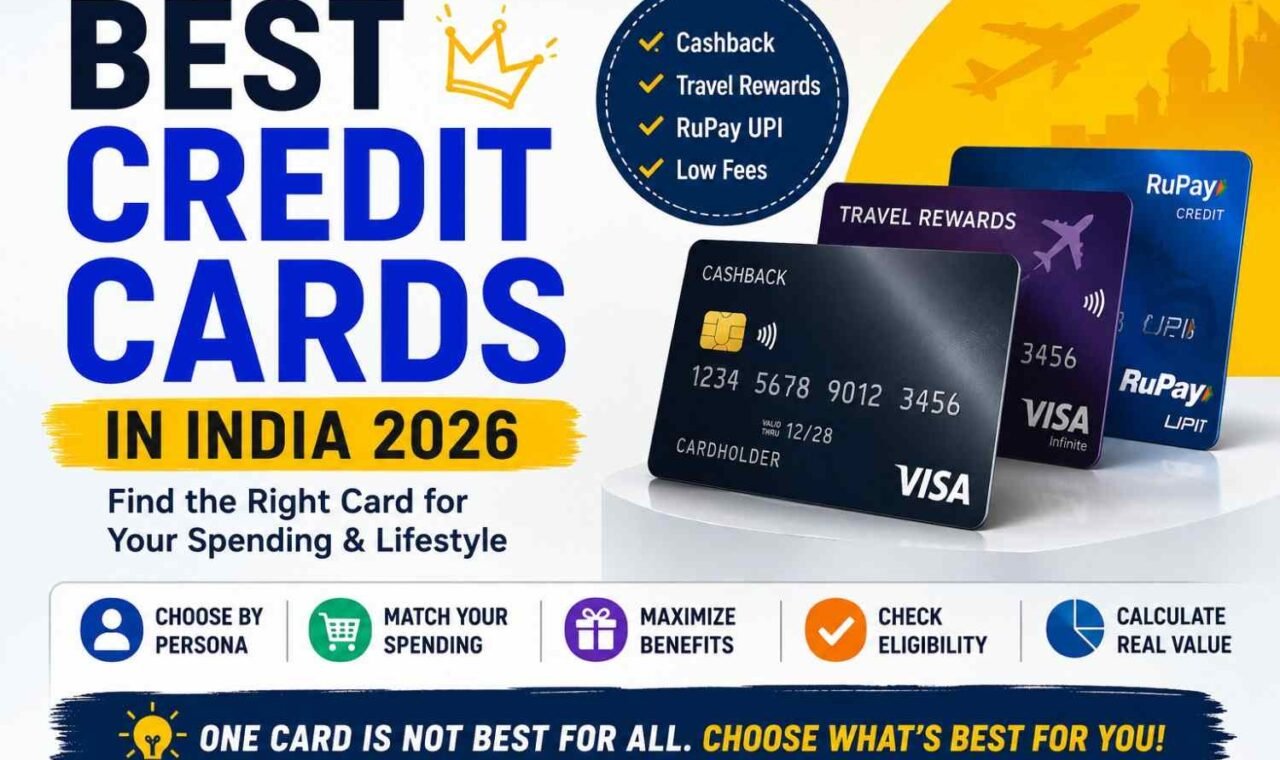
I don’t believe one best credit card fits everybody. Your friend may love a travel card, but for you it may become one more annual fee sitting unused.
Start with your life. Your salary, CIBIL score, old credit history, monthly spending, UPI use, online shopping, fuel, food, and how often you travel. CIBIL itself says payment history, credit utilisation, credit age, and new credit enquiries affect the score.
Then ask simple: cashback or reward points? One easy card or two cards for different spends?
Also check current fees and conditions before applying; card charges must be disclosed to customers.
Here, we will find what card type fits you, your eligibility, real reward value, and when a card is simply not worth taking.
Best Credit Cards by Persona, Income & Eligibility
The best credit cards search should not start from bank name. Start from you. Your salary, where money going every month, CIBIL history, and what benefit you really use.
I seen many people first looking at premium card because lounge, reward points, nice metal look. But after checking eligibility, story become different. A ₹30,000 salary user buying grocery and paying bills need different card than ₹1 lakh income person travelling every month.
| Your Persona | Mostly Spending On | Better Benefit to Look | Main Check |
|---|---|---|---|
| First-time user | Daily expenses | Credit building | Little/no history |
| ₹30K salary | Bills, grocery | Low-fee cashback | Income eligibility |
| ₹40K salary | Food, petrol, shopping | Cashback | Income + credit profile |
| ₹50K salary | Mixed spending | Cashback + offers | Good CIBIL helps |
| ₹1L+ income | Travel, lifestyle | Premium rewards | Higher eligibility |
| Student/new worker | Small spends | Build credit | Thin/NA/NH file |
| Freelancer | Changing expenses | Flexible rewards | Income proof |
| UPI-first user | Merchant QR | RuPay rewards | Card/issuer approval |
| Online shopper | E-commerce | Higher cashback | Merchant limits |
| Frequent traveler | Flights, hotels | Miles + lounges | Higher annual spend |
| Existing user | Many categories | Card combination | Credit history |
Salary itself never giving automatic approval. SBI Card says eligibility can depend on age, income, employment, credit score and other assessment factors. HDFC Bank also says credit-card eligibility and limit can depend on income. So even a person having good CIBIL can still face rejection.
For best credit card for ₹30,000 salary or ₹40,000 salary, I would first look low-fee cashback card. Do not chase premium rewards early. Some cards have quite lower income entry while premium cards demand much more. For example, HDFC lists more than ₹12,000 gross monthly income for its Bharat Credit Card, while Regalia Gold lists ₹1 lakh net monthly income for certain salaried applicants. Eligibility is card-specific, not one fixed bank rule.
What about best credit card for 750 CIBIL score? CIBIL says 750 or above normally puts borrowers in a stronger credit position, but score is not approval guarantee.
And NA/NH score? Don’t panic and send five applications. That can make things messy. A secured or FD-backed route may make more sense for building history first.
My simple rule is this: first get a card you can qualify and manage, then hunt bigger rewards. A beginner does not need premium card to win. Sometimes boring card, paid fully every month, becomes the useful starting card.
Best Credit Cards by Spending Category: Where Does Your Money Go?
Before asking which is the best credit card, I feel one small question matter more. Where your money actually going every month?
I learned this the hard way. A card can show big rewards, shiny welcome offer, airport things. But if you mostly buying grocery and paying bills, those benefits may sit there doing nothing.
Online Shopping
If Amazon is taking a good part of your monthly budget, merchant-linked cashback can make sense. The Amazon Pay ICICI Bank Credit Card currently offers Prime members up to 5% cashback on Amazon purchases.
Flipkart users have similar choices. Current Flipkart-linked cards provide higher cashback on Flipkart, while some also cover Myntra or other preferred merchants.
But think before taking one.
You shop Amazon today. Six months later maybe Flipkart prices are better. Then merchant-specific card can feel little trapped. A general cashback credit card may give lower rate, but works across more websites.
So for a ₹50K-salary Amazon shopper, high Amazon cashback may matter. For somebody shopping everywhere, flexibility may win.
Food, Restaurants and Quick Delivery
Swiggy, Zomato, restaurant bills… small amounts, but month end it becomes big.
For a Swiggy-heavy person, the Swiggy HDFC Bank Credit Card currently advertises 10% cashback on eligible Swiggy spending and 5% on certain online spends.
Still, don’t see “10%” and run to apply.
Check monthly cashback limit, eligible transactions, fee, and your real food spend.
If you spend ₹2,000 only, another simple card could be enough.
Groceries and Quick Commerce
Blinkit, Zepto, Instamart, supermarket, local grocery shop.
Here merchant coding matters. One card may reward online grocery but give ordinary rewards at your nearby store.
My method is simple: check last three statements. Add grocery amount. Online and offline separate.
Then search for best grocery cashback card for salaried beginners based on that number, not advertisements.
Monthly Essentials
Electricity, mobile, broadband, insurance, school fees, OTT, medical bills.
These spends look perfect for rewards because they repeat every month. Problem? Many cards exclude or reduce rewards on some categories.
Read the current terms before applying.
Fuel
Daily commuter should check fuel rewards, surcharge waiver and monthly cap. Brand-specific fuel card works better when you regularly use that fuel company. Otherwise general savings may be easier.
Rent
Rent is tricky. Reward eligibility can be limited and convenience charges may remove the benefit.
So the decision is not “Which card gives biggest percentage?”
It is:
Your income + where you spend + benefit you actually use + card eligibility = the credit card that fits you.
Best Credit Cards for UPI & RuPay Users
I use UPI for very small things also. Tea shop, vegetables, medicine, sometimes ₹50 payment. So for people like me, best RuPay credit card for UPI is not only about big cashback. It should work easily with normal QR spending.
NPCI allows eligible RuPay credit cards to be linked with UPI apps, so you can scan a merchant UPI QR and pay through the linked credit card instead of taking money directly from bank account.
But one confusion comes here. Normal bank-account UPI supports both person-to-person and merchant payments. RuPay credit card on UPI is mainly useful for merchant payments, so don’t think every QR payment will behave same.
And rewards? This part troubled me before. A QR payment happening successfully does not automatically mean cashback came. Your bank may exclude some merchant categories or put reward limits. So I check card reward rules first, not only advertisement.
For me, this simple check works:
| Your spending | Better choice |
|---|---|
| Mostly merchant QR | RuPay UPI credit card |
| Sending money to people | Bank-account UPI |
| Online/offline card shopping | RuPay, Visa or Mastercard based on card benefits |
| Want simple cashback | Check reward rate + monthly cap |
NPCI’s linking process lets a user select the eligible credit card from the issuing bank inside the UPI setup.
So, who should get a RuPay UPI credit card? Someone already scanning merchant QR many times every month. Don’t change your spending only for rewards. First see where your money already goes, then choose the card around that habit.
Cashback vs Reward Points vs Miles: Which Is Best for You?
A credit card saying 5% cashback sounds better than one saying “5 reward points.” But I learned one thing after seeing many card offers: the big number is not always the real value. What matters is what finally comes back to your pocket.
Cashback is easiest. You spend, some money comes back. No thinking much. No flight search. No point conversion.
For a beginner, I usually feel cashback is safer. If you spend ₹20,000 on normal eligible purchases and really get ₹600 back, you know your return. SBI Card, for example, advertises cashback cards with different cashback rates for online and offline eligible spends, but exclusions and limits still matter.
Reward points are little tricky.
A card may give 5 points for spending ₹100. Sounds nice. But what is one point worth?
₹1?
₹0.50?
₹0.20?
That answer changes everything.
I would calculate it like this:
Effective Reward Rate = Real Redeemable Value ÷ Eligible Spend × 100
Say you spend ₹10,000 and earn points which finally give ₹300 useful value.
Your real reward rate is only 3%.
Not whatever big earning number shown in advertisement.
Reward points can still be good for people who spend more and know where bonus categories work. Some cards also allow rewards or miles to move toward airline programs, making them more useful for travel. HDFC Bank, for example, describes cards where earned miles can be transferred to multiple airline partners.
Then comes airline miles and hotel points. This can give very good value, but only for right person.
If you travel often, understand transfer ratios, and can use points for costly flights or hotels, miles may beat plain cashback.
But imagine you fly only once or twice in year. Now you collected 18,000 miles, cannot find useful seat, points sitting there. Cashback would have already paid part of your grocery bill.
So I see it this way:
| Your habit | Better choice |
|---|---|
| Want simple saving | Cashback |
| Spend across bonus categories | Reward points |
| Travel often | Miles/hotel points |
| Travel rarely | Usually cashback |
| Hate reward calculations | Cashback |
| Enjoy optimizing cards | Points or miles |
And which card gives highest cashback? That question alone is incomplete. A 5% card with limits may give less value than a lower-rate card on your actual spending.
Same with one premium card vs several cashback cards. More cards may improve rewards, but also brings more due dates, rules, caps, fees, and headache.
My simple rule: pick rewards you can actually use. A ₹1,000 cashback you receive is worth more than ₹3,000 “possible travel value” you never redeem.
Best Lifetime-Free vs Paid Credit Cards
A lifetime-free credit card sounds simple. No annual fee, so nothing to worry, right? Not always.
“Lifetime free” normally means the bank does not charge the yearly card fee under the offer given to you. But still, other costs can exist. Late payment fee, interest, cash withdrawal charge, forex charge, GST, and some service costs may come separately. So I never see LTF credit card and think everything is free.
Paid cards work different.
You may see ₹500, ₹1,000, even ₹5,000+ yearly fee. That looks bad first. But sometimes the rewards can cover it easily. Sometimes not.
I use this small calculation:
Net Annual Value = Rewards + Benefits Actually Used − Annual Fee − Taxes/Other Costs
Say your card costs ₹1,000 yearly. You earn ₹2,200 real cashback and use ₹800 worth benefits. Your useful value is still positive.
But here is where people get trapped. Airport lounge worth ₹2,000 on paper means nothing if you never visit airport.
Also check:
- Joining fee and renewal fee are not always same.
- Fee waiver may need certain yearly spend.
- Some transactions may not count toward that spend.
- Reward rules and card terms can change.
- Never spend extra only to cross a fee-waiver limit.
For small spenders, a lifetime-free or low-fee high-reward credit card can make more sense.
For higher spenders, paid cards can win.
Your best credit card is not the expensive one. It is the card where real value coming back to you stays higher than real money going out.
Best Credit Cards for Domestic & International Travel
A travel credit card is not good just because airport lounge is written on the card page. I made this mistake before. Lounge looked fancy. Rewards also looked big. But after some months, I understood I was paying fee for benefits I hardly used.
Your travel style matters first.
If you travel only 2–4 times in one year, simple may work better. A cashback card, low-fee card, or even lifetime-free card can give more real value. You book flight, hotel, food, cab, then get some money back. No headache about miles, transfer partners, or points expiry.
For a frequent domestic traveler, the thinking changes. You may need:
- Good rewards on flight booking
- Hotel benefits
- Domestic airport lounge access
- Easy reward redemption
- Useful airline or hotel transfer partners
But check lounge rules carefully. Some cards now ask users to spend a minimum amount in the previous month or quarter before free lounge visits become active. Never trust an old review. Go to the bank website and check the latest lounge terms before applying.
For an international traveler, forex cost becomes a bigger issue. A normal card may charge forex markup every time you pay outside India. So the best low-forex credit card can sometimes save more money than a card giving extra travel points.
Also see global acceptance. Visa and Mastercard are widely accepted, but you should still carry one backup card. I would not travel abroad with only one payment option. Cards fail. Machines fail. Banks block transactions too.
Then comes the luxury traveler. This person may care about airline miles, hotel points, premium lounges, milestone bonuses, concierge help, and travel status benefits. Here, paying a higher annual fee can make sense—but only when you really use those benefits.
Many readers ask, zero-forex vs travel-rewards card? My rule is simple. If your foreign spending is high, first calculate forex cost. If travel rewards are worth more than that cost, reward card wins. If not, low or zero forex can be smarter.
And forex card vs credit card overseas? Forex cards help control currency spending. Credit cards give more flexibility and emergency credit. Many travelers carry both.
The best travel card is not the card with longest benefit list. It is the one matching how often you travel, where you travel, and how much of those benefits you truly use.
Which Are the Best Credit Cards in India?
A best credit card is not simply the card giving biggest reward number. For me, the better card is one that gives useful value on money I was going to spend anyway. Your ₹20,000 online-shopping month and another person’s ₹2 lakh travel month need very different cards.
I would rank these cards by real use, reward strength, spending fit, fee, and difficulty to get, not luxury name alone. Benefits checked against current issuer information in August 2026.
1. HDFC Infinia Metal Edition — Best for High Spenders
This is the card I would look at when spending is already big, especially travel and premium shopping. HDFC gives Infinia users SmartBuy benefits and unlimited airport lounge access. But one problem comes first: you cannot simply decide you want it and get it. HDFC says Infinia is invitation-only, with ₹12,500 joining and renewal fee plus taxes.
So, wonderful card. But wrong target for a beginner earning ₹40,000 and trying to build first credit history.
2. Axis Atlas — Best for Travel Rewards
If you spend money on flights and hotels, Atlas makes more sense to me than chasing plain cashback. Axis currently gives 5 EDGE Miles per ₹100 on eligible travel spends, and 1 EDGE Mile can convert to 2 partner miles under its listed transfer structure. Joining and annual fee is ₹5,000 plus applicable taxes.
This one needs some work from you. Miles are powerful only when you know where to transfer them.
3. SBI Cashback Card — Best for Simple Online Spending
This is easier to understand. SBI currently advertises 5% cashback on eligible online spends and 1% on offline spends.
I like this type when somebody tells me, “I just shop online. I don’t want airline miles, hotel points and too much maths.”
Still, read exclusions. Five percent does not mean every online rupee gets 5%.
4. Airtel Axis Bank Credit Card — Best for Airtel & Utility Bills
This card becomes interesting when your house already uses Airtel. Axis lists 25% cashback on eligible Airtel mobile, broadband, Wi-Fi and DTH payments through Airtel Thanks, plus 10% on eligible utility bills, with cashback caps and conditions.
For someone paying these bills every month, small regular savings can matter more than airport luxury.
5. HDFC Regalia Gold — Best Balanced Travel & Lifestyle Card
Regalia Gold sits in a more reachable middle area. HDFC currently highlights reward points, selected-brand multipliers, airport lounge benefits and milestone vouchers.
That makes it useful for a person who travels sometimes, shops regularly, but does not need an ultra-premium card.
My simple rule: don’t ask only, “Which is India’s best credit card?” Ask, “Where do I spend, what benefit will I actually use, and can I recover the card fee?” That question normally leads to a much better card.
6. HDFC Diners Club Black Metal — Best for Premium Rewards
Diners Club Black Metal sits just below the ultra-premium Infinia type user, but still it is not a normal everyday card.
HDFC currently gives up to 10X Reward Points through SmartBuy, unlimited access to 1,300+ airport lounges in India and abroad, and a 2% foreign-currency markup. The joining and renewal fee is ₹10,000 plus taxes. Renewal fee can be waived after ₹8 lakh spending in the previous 12 months.
The eligibility itself tells us who this card is made for. HDFC currently asks salaried applicants for net monthly income above ₹2.5 lakh.
Good card, yes. But don’t force yourself into it just because reward numbers look attractive.
7. American Express Platinum Travel — Best for Milestone Travelers
I see this card differently from normal cashback cards.
American Express Platinum Travel mainly becomes interesting when your yearly spending can hit its milestone levels. You collect Membership Rewards points, while travel benefits and milestone rewards make the card more useful for somebody already spending regularly through credit cards. Amex also currently lists 8 complimentary domestic lounge visits per year, limited to two per quarter.
This is for a person willing to plan spending. If your spending is very small, chasing milestones may become unnecessary pressure.
8. ICICI Emeralde Private Metal — Best for Luxury Lifestyle Users
This card is more about premium treatment than saving ₹200 on groceries.
ICICI currently lists a ₹12,499 + GST joining fee and annual fee for Emeralde Private Metal. The bank positions it as its luxury metal credit card with premium travel and lifestyle benefits.
That fee is big.
So before applying, I would calculate how many lounges, travel benefits, rewards and premium services I will genuinely use. If most benefits stay unused, the expensive card becomes only a metal piece in wallet.
9. Axis Magnus for Burgundy — Best for Very High Spenders
Magnus for Burgundy enters a different level again.
Axis currently lists an annual fee of ₹30,000 plus taxes, waived when previous-year spending reaches ₹30 lakh. It also provides conversion of EDGE Reward Points into partner miles, subject to its current transfer rules.
This is clearly not a “best credit card for ₹30,000 salary” type product.
For somebody already inside the Burgundy banking ecosystem and spending heavily on travel or lifestyle, the maths can work. For average users, simpler cashback cards usually make more sense.
10. HDFC Millennia — Best for Mainstream Online Shoppers
Millennia feels much more practical for normal online spending.
HDFC currently promotes 5% cashback on Amazon, Flipkart, Myntra, Swiggy, Zomato and other selected merchants. The joining and renewal fee is ₹1,000 plus taxes, with renewal-fee waiver after ₹1 lakh annual spending under current terms.
This is why I put Millennia closer to the everyday shopper.
You don’t need luxury travel plans. If most of your money already goes toward online shopping and food platforms, a simple cashback structure may give more usable value than complicated miles.
One thing I keep noticing: the “best credit cards in India” list changes completely when the person changes. A ₹3 lakh-a-month premium traveler may value Diners Black or Magnus. A regular Amazon, Swiggy and Flipkart user may get more real happiness from Millennia. Reward value matters only when it matches your real spending.
Why Advertised “5%–10% Cashback” May Not Equal Your Real Reward Rate
You see 5% cashback. Sometimes 10%. Looks very nice.
But that number alone tells little.
I always feel cashback should be checked like this: how much money finally came back to your statement? Not what big number shown on card page.
Suppose your monthly card spend is ₹30,000.
Advertised cashback: 5%
Expected by you: ₹30,000 × 5% = ₹1,500
Monthly cashback cap: ₹1,000
Money actually earned: ₹1,000
So your real reward rate is only:
₹1,000 ÷ ₹30,000 × 100 = 3.33%
That is the number I care about.
And caps are only one issue. Some cards have monthly cap, some category cap, quarterly limit, or yearly milestone rules.
Then comes MCC, or Merchant Category Code. Bank sees your payment based on merchant coding. You may think it was normal shopping. Bank may see different category. Then reward not coming.
Many cards also keep some spends outside reward system. SBI Card, for example, says its Cashback SBI Card excludes categories such as utility, insurance, fuel, rent, wallet and school payments, along with Merchant EMI and Flexipay EMI transactions.
HDFC Bank also states that, for Millennia, wallet loading, Easy EMI and education payments do not earn Reward Points from September 1, 2024.
So before saying, “My card gives 5%,” check:
- Where 5% applies.
- Which merchants qualify.
- Monthly or quarterly cashback cap.
- Rent, fuel, insurance and education exclusions.
- Wallet and government payment rules.
- EMI eligibility.
- Gift-card rules.
- Refund treatment.
- Reward expiry.
- When cashback reaches your statement.
Refund is another small trap. You earn reward, later return product, then bank may reverse related reward under card terms.
And points can expire too. SBI Card says reward points on most of its cards remain valid for 24 months, after which unused points can be forfeited.
So never ask only, “Which credit card gives highest cashback?”
Ask this instead:
“After caps, exclusions, MCC rules and my actual spending, what cashback will I really keep?”
That question saves more money.
The Credit-Card Terms You Must Check Before Applying
A credit card can look great on the bank page. Big cashback. Free lounge. Welcome points. I used to notice these first too. But the small MITC page is where the real cost sits.
MITC means Most Important Terms and Conditions. Before applying, open the latest one from the card issuer. RBI rules require important fees and charges to be clearly disclosed, including cash-advance fees, finance charges and other card costs.
I check these first:
| Check | Why it matters |
|---|---|
| Joining/annual fee | Your reward must recover this cost |
| GST | Fees may cost more after tax |
| Fee-waiver spend | Missing it can mean another annual fee |
| Reward rate/cap | 5% sounds nice, but caps can cut real return |
| Excluded spends | Rent, fuel, EMI or some bills may earn nothing |
| Reward expiry/redemption fee | Points can lose value |
| Forex markup | Important when you spend abroad |
| Lounge rule | Free access may need minimum spending |
| EMI terms | Conversion can carry interest or other charges |
| Card network | RuPay, Visa or Mastercard use may differ |
Then I look at the ugly side: late-payment fee, finance charges, cash withdrawal fee and over-limit charge. Never skip this part. RBI says late-payment related charges can be levied only on the outstanding amount after adjusting payments or refunds.
Also see add-on card rules and cash withdrawal terms. Cash from ATM is not like normal shopping; finance costs can make it expensive.
So, what should I check in the latest MITC before applying? Simple. Don’t only ask, “How much reward I get?” Ask, “What can stop me getting that reward, and what can make this card cost me money?” That small question saved me from many shiny offers.
Credit Score, Credit Utilisation & Approval Chances
A good reward card looks nice until application get rejected. Or worse, you get card, spend too much for cashback, and credit profile becomes weaker. I have seen people focus on 5% reward but ignore the bigger thing — how they are using credit.
CIBIL score runs from 300 to 900. CIBIL says a score above 700 is generally considered good, while its older consumer guidance describes 750+ as a good CIBIL score. Still, 750 does not mean bank must approve you.
Bank may also check your income, employer, city/service area, existing loans, recent applications and its own internal lending rules.
If your report shows NA or NH, usually there is not enough credit history to produce normal score. In that situation, chasing premium cards first may not help. A basic or secured card, used slowly, can start building history.
What matters inside your credit profile? CIBIL mainly points to payment history, credit utilisation, age of credit and enquiries.
Credit utilisation is easy to miss.
If your total limit is ₹1,00,000 and statement balance often reaches ₹80,000, lender can see heavy credit use. CIBIL itself suggests keeping overall credit-card spending around 30% of available limit as healthy behaviour.
Paying before statement date can reduce the balance reported, but don’t make life difficult just to show zero usage. Most important thing: pay the full amount due on time.
Applying for many cards together can create several hard enquiries. One enquiry is not disaster. Repeated new-credit hunting can hurt your profile because enquiries are part of CIBIL scoring.
Having many cards itself is not automatically bad. Bad handling is.
One missed payment may also hurt because late and missed payments can negatively affect CIBIL score.
And don’t quickly close your oldest card only because rewards became boring. Older responsibly used accounts can support longer credit history. Sometimes boring card is quietly doing useful work.
So before asking, “Which is the best credit card?”, ask another question first:
“Can I manage this card without hurting my credit?”
11. 7-Step Framework to Choose Your Best Credit Card
Finding the best credit card should not start with a bank ad. I feel it should start with your own wallet. Because one card may look great online, but for your spending, it may do almost nothing.
Step 1 — Check Your Last 6 Months Spending
Open your bank app, UPI history, or old statements. See where money really went.
Do not guess.
Add total spending for six months, then find your average monthly spend. You may think shopping is your big cost, but sometimes groceries, food orders, fuel, and bills quietly take more.
Step 2 — Put Spending Into Small Groups
Make simple buckets:
- Shopping
- Food
- Grocery
- UPI
- Fuel
- Bills
- Travel
- Other spending
This small work can change your card choice fully.
Step 3 — Decide What You Actually Want
Ask yourself one thing: Why I need this card?
Maybe you want cashback. Maybe airline miles. Some people only want airport lounge access. A new user may just want credit building. International travelers may care more about low forex markup. And some people, including me sometimes, prefer simple rewards rather than tracking ten offers.
Step 4 — Check Eligibility Before Applying
Now look at income requirement, CIBIL score, job type, city, and bank relationship.
A good-looking card is useless if your profile does not fit. Also, applying everywhere after rejection can create more hard enquiries.
Step 5 — Find the Real Reward Rate
Do not stop at “5% cashback.”
Check monthly caps, merchant limits, excluded spends, rent, fuel, wallet, EMI, and other rules.
Your real return can be much lower.
Step 6 — Calculate Annual Net Value
Use this:
Rewards + useful benefits − annual fee − taxes = real yearly value
If a ₹2,000 fee card gives only ₹1,200 useful value to you, that card is not rewarding you. You are paying for it.
Step 7 — Pick One Main Card, Then One Backup If Needed
Keep one card for most spending. Add another only when it covers a clear gap, like UPI, travel, fuel, or online shopping.
Three cards doing the same job usually creates more tracking, more due dates, and more confusion.
The best credit card for you is not the card with the loudest offer. It is the card that fits your spending, your goal, and your eligibility without making your money life harder.
Best Credit-Card Combinations for Different Spending Personas
Many people ask me, how many credit cards should I have? One card or three cards? I had same confusion too. One card feel easy. But sometimes it gives weak reward in many places.
For beginner, I usually like simple one-card setup. You use one good cashback card for shopping, food, bills, maybe fuel also. Less tracking. Less missed payment chance. If your monthly spend is small, chasing five cards not making much sense.
Then comes two-card cashback setup. This is useful for many normal users.
| Card Role | Use it for |
|---|---|
| Main cashback card | Daily shopping, food, bills |
| Special card | Amazon, UPI, groceries or one strong category |
Suppose your first card gives flat cashback. Your second RuPay credit card may handle UPI merchant payments. Now you are not forcing one card to do every job.
A three-card optimization setup can work when spending is larger. One card for shopping and food. Another for UPI and utilities. Third for travel or fuel. But here headache starts also. Different due dates, reward limits, exclusions, annual fees.
Premium users may keep one travel rewards card, one high cashback backup, and one low-forex card for foreign spend.
But please don’t collect cards like trophies. I seen people spend extra ₹2,000 just to earn few hundred reward. That is backwards.
My rule is simple: add another card only when it solves one clear spending problem. If two cards give same benefit, one probably not needed.
Common Credit-Card Problems and Practical Resolutions
Credit card looks simple when applying. Use card, get cashback, pay bill. But real life not always working like this.
You may have good CIBIL score and still card application gets rejected. I have seen people thinking, “My score is good, then why bank saying no?” Because score is only one part. Income, address service area, recent credit enquiries, bank internal rules, KYC and existing credit also can matter. CIBIL itself says frequent hard enquiries may affect your credit profile. So after few rejections, don’t keep applying everywhere. Stop for some time, check your CIBIL report, and first find cards matching your eligibility.
Video KYC can fail for a silly reason too. Bad light. PAN details mismatch. Network stopped. Wrong address. Try fixing that issue before another application.
Rewards create another headache.
Your card says 5% cashback, but statement showing less. Why?
Maybe monthly cashback limit finished. Maybe merchant used different MCC (Merchant Category Code). Sometimes rent, fuel, wallet load, education, EMI or gift-card purchase may be excluded. Reward points can expire too. Airline miles transfer can fail, or bank may remove one transfer partner.
So, don’t argue only from memory. Open issuer reward terms. Match transaction date, amount, merchant, MCC if available, and cashback cap. Keep screenshot or statement proof.
Travel problems hurt more because they happen at bad time. Lounge machine says declined while you are standing near the gate. International card transaction suddenly fails. Sometimes lounge spend condition was not met; sometimes international usage was switched off. Forex markup can also make your “reward” feel small.
Payment trouble needs faster action.
If payment is not reflected, keep payment reference number and contact issuer. If autopay failed, manually pay quickly instead of assuming bank will fix it. Paying only minimum due again and again can keep debt running because remaining balance can attract finance charges.
High card balance also matters. CIBIL identifies payment history and credit utilisation among factors affecting credit health.
My simple recovery order is:
Check statement → read card terms → save proof → contact issuer → escalate if unresolved.
If your credit report itself is wrong, raise a dispute with CIBIL.
And for serious unresolved card complaints, RBI provides an Ombudsman complaint route after going through the regulated entity’s grievance process.
Sometimes best recovery is not finding another “best credit card.” It is fixing the old problem first.
What to Do If Your Credit Card Is Lost, Stolen, Charged Incorrectly or Misused
Credit card fraud feels small until that strange SMS comes. ₹8,000 spent somewhere, but you never bought anything. First thing, don’t wait to understand who did it. Block or freeze your card immediately. Then report that unauthorized transaction to your card issuer.
Speed matters here. RBI says customers should tell the bank about unauthorized electronic transactions at the earliest. In certain third-party fraud cases, reporting within 3 working days can mean zero customer liability. Waiting 4–7 working days may bring limited liability, depending on the case.
I would keep everything. Transaction SMS, email, screenshot, merchant name, date, amount, complaint number. Small proof may become big proof later.
If same transaction charged twice, or purchase you never made showing in bill, raise a transaction dispute. Ask issuer whether a chargeback is possible for that transaction. Do not just remove SMS and forget.
After replacement card comes, check its controls and watch next few statements too. Sometimes problem look finished, but another charge may appear.
And who pays for fraudulent transactions? It depends how fraud happened and how fast you reported it; RBI rules do not make every fraud automatically customer’s loss.
Bank not solving it? Keep the complaint reference. Under RBI’s current Integrated Ombudsman Scheme, 2026, you normally approach the issuer first. If no reply comes within 30 days—or you are unhappy with its resolution—you may approach the RBI Ombudsman, subject to the applicable complaint rules.
What to Do When Your Credit Card Benefits Are Devalued
Credit card devaluation can feel bad, mostly when you picked that card for one strong benefit. Maybe cashback became smaller. Maybe reward cap dropped. Or airport lounge now asks you to spend more before entry. This is happening with many cards, and benefits can change even after you already got the card. HDFC Bank, for example, changed lounge and reward rules on some cards in 2026, including spend-based lounge conditions.
I normally don’t cancel fast. First I check old value against new value.
Old annual value − old fee
versus
New annual value − new fee
Then decision become little easy.
Retain → Downgrade → Replace → Close
Retain it when cashback, rewards, lounge or miles still cover your yearly fee. Downgrade when annual fee increased but card still useful. Replace when reward caps became too low, new exclusions hit your main spending, transfer ratio became poor, or airline/hotel partners disappeared. Axis Bank’s travel program, for example, removed some transfer partners in April 2026.
Close only after checking unused points, pending cashback, EMIs and auto-payments.
Also don’t trust last year’s review forever. SBI Card has changed reward redemption rules and limits during 2026 too.
So, should I cancel after devaluation? Not always. Check your own spend again. A bad card for one person may still work fine for you.
16. Persona + Spending + Benefit + Eligibility Matrix
Finding the best credit card is not same for every person. I seen many people choose card because cashback looks big, then later they found annual fee, low reward cap, or their normal spending not even earn much. That is where wrong choice start.
You should first see four things: who you are, where money goes, what benefit you want, and whether you can qualify.
| Persona | Main Spending | Wanted Benefit | Eligibility | Better Card Type |
|---|---|---|---|---|
| Beginner | General | Build credit | No history | LTF/secured |
| ₹30K salaried | Essentials | Cashback | Entry level | LTF cashback |
| ₹40K salaried | Food + UPI | Cashback | 700–750+ | RuPay/cashback |
| ₹50K salaried | Shopping + bills | Cashback | Good credit | Category cashback |
| ₹1L+ salaried | Mixed/travel | Rewards | Strong profile | Premium rewards |
| UPI-heavy | QR payments | UPI rewards | Eligible income | RuPay |
| Amazon-heavy | Shopping | Cashback | Standard | Co-branded |
| Grocery-heavy | Grocery/quick commerce | Cashback | Standard | Category card |
| Frequent diner | Restaurants | Offers/rewards | Moderate+ | Dining card |
| Commuter | Fuel | Fuel savings | Standard | Fuel card |
| Domestic traveler | Flights/hotels | Lounge/miles | Moderate+ | Travel card |
| International traveler | Foreign spend | Low forex | Moderate+ | Forex/travel |
| Premium traveler | Heavy travel | Miles/status | High income | Premium |
| Simplicity seeker | Everything | Flat cashback | Standard | General cashback |
| Optimizer | Many categories | Maximum return | Strong profile | 2–3 card stack |
Think of your last few months spending. Not what you plan to spend. Your real spending.
If ₹15,000 goes to Amazon, grocery and bills, then fancy airport lounge may mean nothing. If you fly often, flat 1% cashback may feel weak.
So the best card is usually simple equation:
Your spending + useful benefit + realistic eligibility = better card choice.
Choose card for your life. Not change your life for card rewards.
Frequently Asked “Best Credit Cards” Questions
Credit card looks simple until you start using one. Then small doubts come. I had same feeling while comparing cards—one card says cashback, another says points, but real value depends on your spending, income, credit history, fees, and habits.
Eligibility
What is easiest credit card to get?
Usually entry-level or FD-backed card. If credit history is missing, secured card can be easier path.
What CIBIL score is required?
No one score guarantees approval. CIBIL score runs from 300 to 900, while bank also checks income and its own rules.
Can I get card without credit history?
Yes. Try secured or beginner card and build history slowly.
Need bank account with same bank?
Usually no. But existing bank relation sometimes makes process easier.
Why rejected even with 750+ CIBIL?
Score is only one part. Income, recent applications, location, documents or bank rules can stop approval.
How long after multiple rejections?
Don’t immediately apply everywhere. Too many credit enquiries can hurt your credit profile.
Can beginner get premium card?
Possible, but income and issuer eligibility normally matter more than wanting premium benefits.
Rewards
Which card gives highest cashback?
There is no permanent winner. Check your spending category, cashback cap and exclusions.
Are reward points worth it?
Yes, only when redemption gives useful value to you.
Cashback or miles?
Cashback is simple. Miles can suit frequent travelers.
When cashback appears?
Depends on issuer rules. Check statement cycle and reward terms.
Why my purchase got no rewards?
Often MCC, monthly cap or excluded spending caused it.
Do EMI, rent, utilities or insurance earn rewards?
Sometimes. Many cards exclude or reduce rewards here. Read latest terms.
Credit Score
How many cards is too many?
No magic number. Keep only cards you can manage properly.
Does closing card hurt CIBIL?
It can change available credit and credit history.
Do applications affect CIBIL?
Lender enquiries are part of CIBIL score factors.
Is 80% utilisation bad?
It is very high usage. Lower utilisation gives you more breathing space.
Pay before statement or after?
Either can work; never miss full payment by due date.
What if I pay minimum due only?
Debt remains and interest-free benefit may be lost.
Usage
Visa, Mastercard or RuPay?
Choose by acceptance and benefits. RuPay credit cards can work with UPI.
Can I link RuPay card to UPI?
Eligible RuPay credit cards can be linked through supported UPI apps.
Which card for each expense?
Use strongest card for shopping, food, UPI, fuel or travel—not randomly.
Is card optimization worth it?
Only if extra rewards are bigger than fees and your headache.
How much cashback yearly?
Calculate from your real eligible spending, not advertised percentage.
Safety
Card stolen?
Block it immediately and contact issuer.
Unauthorized transaction?
Report fast. RBI provides customer-liability protection rules for unauthorized electronic transactions.
Cashback missing?
Check cap, MCC and terms first, then raise complaint with issuer.
Bank not solving complaint?
Use bank grievance process first, then RBI complaint route where eligible.
How We Evaluate the “Best Credit Cards”
I don’t trust a credit card only because bank page says “best rewards”. You also should not. Small rule can kill big reward.
For every best credit cards pick, I first check eligibility, joining fee, renewal fee, fee-waiver spend, base rewards, accelerated rewards, cashback cap and reward expiry. Then comes the boring part people often skip—MCC restrictions, excluded spends, forex markup, lounge conditions and point redemption value.
I calculate what you may really get in one year:
Real annual value = usable rewards + benefits you actually use − yearly card cost
This matters. A 5% cashback card can give less value when monthly cap comes early.
I also check issuer’s current card page and MITC before keeping any number. Benefits can change. For example, HDFC Bank currently ties Millennia lounge eligibility to quarterly spending milestones, showing why old reviews may become wrong.
Credit safety gets same weight. RBI’s card directions cover consent, billing and customer protection rules. CIBIL says payment history, credit utilisation, credit age and enquiries help form your credit profile.
Where possible, I compare actual reward tracking, anonymized statements, approval or rejection experience, and card devaluations too.
Last verified: August 17, 2026.
If affiliate links exist, they never decide ranking. Card usefulness does.
Final Answer: Which Credit Card Is Best for You?
The best credit card is not same for every person. I learned this after seeing people choose card because friend said it is good, then later fee become bigger than rewards.
You need see your own life first.
Your profile + where you spend + benefit you want + eligibility + real yearly value = your right credit card.
If you are beginner, simple low-fee or lifetime-free card may work better. Everyday spender? Cashback is easy, money comes back without much thinking. If most payment happen through UPI, a RuPay credit card can make more sense.
Travel often, then miles, lounge access and low forex fee matters.
High spender can look premium cards, but only when rewards are more than yearly cost.
And if building CIBIL, forget fancy rewards first. Pay full bill, on time.
Never spend ₹1,000 extra just to earn ₹50 reward. That is not saving.