
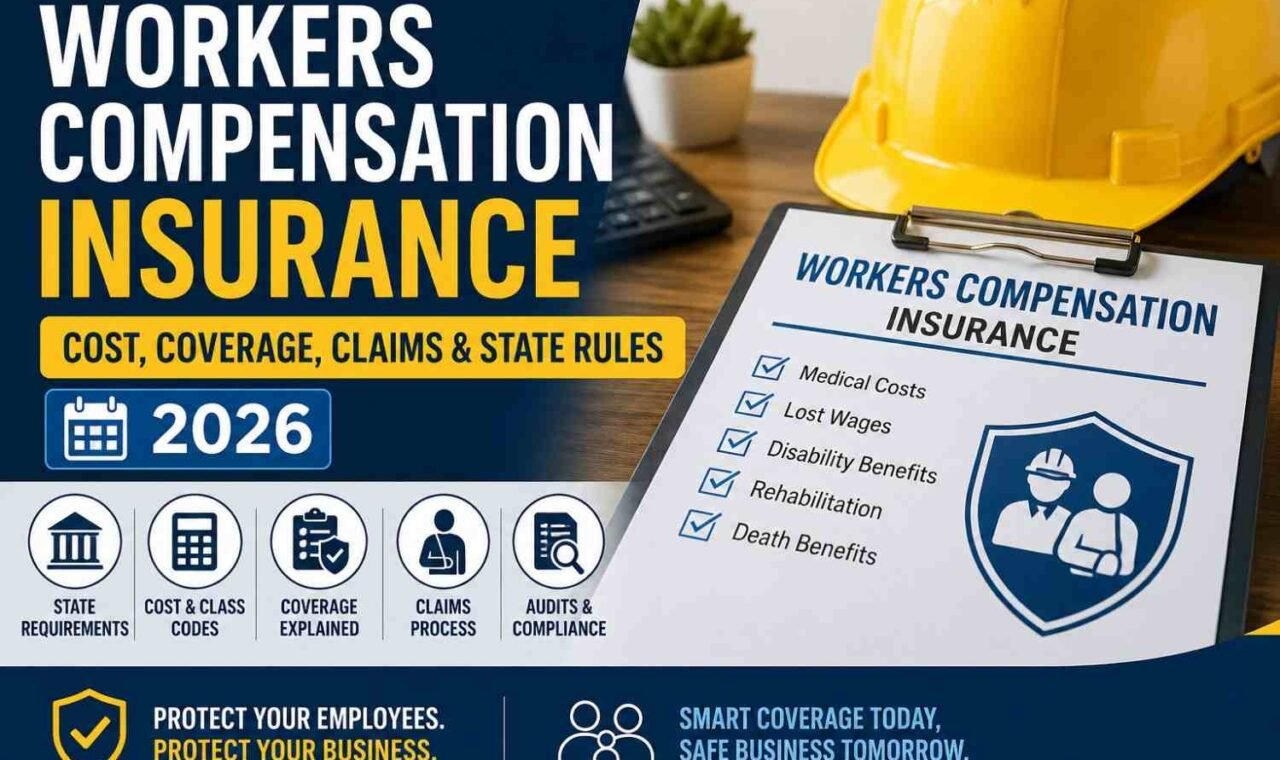
Workers compensation insurance can help when your employee gets hurt or sick because of work. It may pay medical treatment, wage replacement, rehabilitation, and other allowed benefits.
But one mistake I see often. People ask, “How many employees before workers comp is required?” like one U.S. rule fits everybody. It does not work that simple.
Your state matters first.
Private-company and state/local government workers generally deal with their state workers compensation system, not one national program.
So before checking workers comp cost or quotes, find your state in the U.S. Department of Labor state workers’ compensation directory.
Do I Need Workers Compensation Insurance? Start With Your State
Before checking price, first check your state rule. This part people skip. Then trouble comes later.
Workers compensation insurance is not one same rule across America. California says an employer with one or more employees must meet workers comp requirements. Florida is different: construction employers generally need coverage with one or more employees, while many non-construction businesses reach the rule at four or more employees. Texas goes another way again—most private employers can choose whether to carry workers compensation insurance.
I would never start with “Which insurer is cheapest?” Start with: Is workers comp required for my business?
| State | Who Generally Needs Coverage | Important Exceptions | Official Agency |
|---|---|---|---|
| California | Employers with 1+ employees | Some owner/officer rules differ | Division of Workers’ Compensation |
| Florida | Construction: 1+; many non-construction: 4+ | Entity and owner status matters | Division of Workers’ Compensation |
| Texas | Most private employers may choose coverage | Government entities must carry coverage | Texas Division of Workers’ Compensation |
| New York | Virtually all employers need coverage | Specific exemptions and situations exist | Workers’ Compensation Board |
Owners, LLC members, corporate officers, contractors, part-time workers—these details can change answer. Even working across state lines matters. New York, for example, has specific coverage rules for out-of-state employers with people working there.
So don’t guess from your employee count alone. Find your state in the U.S. Department of Labor state workers compensation directory, open that state agency, then check your business type and worker status.
Next useful section: Check Your Business Structure—LLC, Sole Proprietor, Partnership or Corporation.
Step 2 — Check Your Business Structure
Your business name on paper matters more than many owners think.
A sole proprietor with no employees may not need workers compensation insurance in some states. New York, for example, says a sole proprietor without employees is not required to carry it, but can choose coverage.
Then LLC comes. People ask me, “Does an LLC need workers comp?” There is no clean yes for whole America. LLC owner, partner, corporate officer, employee status, state law—all can change answer.
Corporations get tricky too. In California, officers and directors generally come under coverage while working for pay, though qualifying owners may elect exclusion under certain rules.
Texas shows another path: a sole proprietor, partner, or certain corporate executive officer under a covered business may be excluded through policy endorsement when law allows.
So never think, “I own business, I am automatically exempt.”
Check:
Your state → business type → ownership → officer role → employees → written exclusion rules.
The U.S. Department of Labor links each state workers compensation authority, good place to verify before buying policy.
Step 3 — Count Your Workers Correctly
“I have only two employees, so I don’t need workers compensation insurance.” I hear this kind of thinking often. It can become expensive mistake.
Your worker count is not only full-time people sitting in office.
Check everyone doing work for your business:
- Full-time employees
- Part-time workers
- Seasonal help
- Temporary staff
- Family members working in business
- Interns
- Remote employees
Here is where things become messy. State rules are not same.
In California, an employer with one or more employees generally must meet workers’ compensation requirements. Texas goes very different way: most private employers are not required to carry workers’ comp coverage.
So don’t stop at, “How many employees do I have?”
Ask better: Who legally counts as my worker in this state?
I would make one simple worker list. Name, job type, work state, full-time or part-time, temporary or permanent. Then check your state workers comp agency before buying or skipping coverage.
Next, the important problem is deciding employee vs independent contractor, because a 1099 label alone can create another surprise.
Step 4 — Employee or Independent Contractor?
This part cause big trouble for many small business owners. A worker gets a 1099, so owner thinks, “Okay, contractor. No workers comp.” But that paper alone does not decide it.
IRS says worker status depends on the real working relation. Things like who controls the work, who controls money side, and how both sides work together matter. A 1099 itself is not enough proof.
I seen this problem many times in business discussions. Person called subcontractor, but company tells him when to come, where to work, what tool to use, how job must be done. That starts looking different.
| Worker Situation | What to Verify |
|---|---|
| Gets 1099 | Actual work relation, not form only |
| Uses own tools | Who controls work and schedule |
| Works only for you | Level of dependence |
| Subcontractor | State workers comp rules and insurance proof |
| Has own company | Still check real job setup |
Misclassification can become costly when injury happen, audit comes, or state agency checks records.
Also, rules are moving. U.S. Department of Labor proposed a new worker-classification rule in February 2026, so federal guidance is still changing.
For workers compensation, always check your state rule too. Federal tax or labor status does not automatically answer state workers comp status.
Next useful section is Step 5 — How Your Industry Changes Workers Comp Risk, because class codes and price start making much more sense after this worker-status check.
Step 5 — Your Industry Changes Your Workers Comp Risk
Same payroll. Same number of workers. But workers compensation insurance cost may look very different.
Think office worker first. Mostly desk, computer, chair. Now roofing worker. Heights, ladders, tools, hot roof, one bad step. Risk is not same.
Retail brings lifting and slips. Restaurant has knives, heat, wet floors. Healthcare workers may lift patients. Manufacturing got machines. Trucking brings road crashes. Landscaping has equipment and outdoor work. Construction and roofing can carry much harder injury risk.
This is why workers comp class codes matter. NCCI even separates industry groups such as office, retail, transportation, manufacturing and construction when studying workers compensation results.
I would not tell insurer only, “We have $300,000 payroll.” Tell them what your people actually do. That small detail can change the whole workers comp quote.
Step 6 — Understand Workers Comp Class Codes
Workers comp class codes look small, but wrong code can make your premium go very wrong.
A class code tells insurer what kind of work your people really doing. Office clerk sitting with computer is not same risk like roofer climbing house. So job duty matters more than fancy job title. NCCI says its workers compensation system has 600+ classifications, with state exceptions also built into the rules.
I seen this mistake many business owners can easily make. They say, “My company is construction, so all workers same code.” Not always. Some businesses may have more than one classification when workers do clearly different duties and rules allow it.
Clerical workers can be another confusing part. A person truly doing office work may fall under different treatment than field worker, but you cannot just call someone “clerical” only to save money.
Before accepting any NCCI class code lookup result:
- Write actual daily duties.
- Check correct state.
- Compare code wording.
- Ask insurer or agent when duties overlap.
NCCI’s Class Look-Up includes state phraseology, rates/loss costs and state-special classifications. Some states use independent bureaus or other systems, so never assume one NCCI code works same everywhere.
Next useful section would be Step 7 — how workers comp cost is calculated, because class code starts making real sense when connected with payroll and rate.
Step 7 — How Much Does Workers Compensation Insurance Cost?
Workers comp insurance cost is not one fixed number. I wish it was that easy.
You may see somebody say, “workers comp cost per employee is this much.” Be careful. Your business can be very different from theirs.
A simple starting math looks like this:
Payroll ÷ $100 × applicable rate = starting premium component
NCCI explains that workers compensation rates are commonly applied to each $100 of payroll, with different job classifications carrying different rates. A roofing job, for example, normally carries more injury risk than office work.
Hypothetical example
Say your business payroll is $300,000.
Suppose the rate is $1.25 per $100 payroll. This is only an example, not a real quote.
$300,000 ÷ 100 = 3,000
3,000 × $1.25 = $3,750
So, $3,750 becomes a starting premium piece. Final price may move after other rating items.
Your real cost can change because of:
- payroll amount
- type of work and class code
- state or location
- past claims
- experience modification, or EMR
- insurance company pricing
- other policy adjustments
Texas insurance regulators, for example, say employee payroll is assigned to classifications and multiplied by the insurer’s rate for that classification. They also note rates can differ between insurance companies.
I would never compare quotes using price alone. First check class code and payroll. One wrong detail there can make a cheap workers comp quote look good now, then painful when audit comes.
Next, it makes sense to explain claims history and EMR, because that is where many business owners suddenly understand why their price moved.
Example Workers Comp Cost Calculation
Take a simple made-up example:
| Item | Example |
|---|---|
| Annual payroll | $300,000 |
| Payroll units | $300,000 ÷ 100 = 3,000 |
| Illustrative rate | $1.25 per $100 |
| Starting premium | $3,750 |
$300,000 ÷ 100 × $1.25 = $3,750
That $1.25 rate is only an illustration. It is not a real quote or national average.
Actual premium can change after experience rating, schedule credits/debits, company pricing and other allowed adjustments. NCCI also shows experience modifiers being applied after classification premium is calculated.
And there is another small 2026 detail worth knowing. NCCI began proposing three-decimal-place loss costs and rates for filings effective January 1, 2026 and later in jurisdictions where approved. So you may now see rates looking like 1.946 instead of just 1.95.
Before accepting any workers compensation insurance quote, check payroll + class code + rate + EMR + final adjustments together. One cheap-looking number alone tells very little.
Next useful section would be Step 8 — Claims History and Your Experience Modification Rate (EMR), because that explains why two similar employers can still receive quite different workers comp prices.
Step 8 — Claims History and Your Experience Modification Rate (EMR)
Your workers comp claims history can follow business for years. I seen owners forget this part. They only checking quote price.
An experience modification rate (EMR) looks at your past losses against losses expected for similar risk. NCCI says its experience rating uses losses from a three-year experience period to help calculate the Mod for a future policy period.
Simple way I think about it:
| EMR | Rough meaning |
|---|---|
| Below 1.00 | Loss experience may be better |
| Around 1.00 | Near expected |
| Above 1.00 | Loss experience may be worse |
But don’t call 1.00 a magic “good EMR.” Eligibility, formulas and rating rules can change by state and rating system.
Small claims matter too. Frequency can tell a bad story even when each accident looks cheap.
Interesting part: NCCI estimated lost-time claim frequency fell 2% in 2025, while medical and indemnity claim severity each went up 4%.
So, fewer claims not mean cheap claims.
I would review loss runs, open claims, safety problems and return-to-work plans before renewal. Better claims management today can help your future workers compensation insurance cost.
Step 9 — What Does Workers Compensation Insurance Cover?
Workers compensation insurance mainly helps when an employee gets hurt or sick because of the job. Sounds simple. But when real accident happen, many small details start coming.
A worker may fall from ladder. Another may get back pain after lifting boxes for months. Sometimes problem comes slowly, like illness caused by work exposure. Workers comp may help with medical treatment, lost income and rehabilitation, depending on state rules. The U.S. Department of Labor lists medical treatment, wage replacement and vocational rehabilitation among core workers compensation benefits.
| Potential Benefit | Example |
|---|---|
| Medical treatment | Doctor visit, hospital care or treatment for work injury |
| Wage replacement | Part of lost wages while worker cannot work |
| Rehabilitation | Help worker recover or return to suitable work |
| Disability benefits | Temporary or permanent disability payments where eligible |
| Occupational disease | Illness linked with workplace exposure |
| Death benefits | Payments to eligible dependents when job injury or disease causes death |
One thing I tell people: workers comp is not general liability insurance. General liability mainly handles claims from customers or other third parties. Employers liability is another related protection for certain employee lawsuits not handled the same way under workers comp.
And don’t guess coverage. Your state rules decide much of this.
What Workers Comp Usually Doesn’t Cover
Workers comp insurance not mean every injury gets paid. This part confuses many people.
Say you hurt your back fixing something at home on Sunday. Not work. Usually that is not a workers compensation claim. Main question often becomes simple but messy: did injury arise from the job and happen while doing work? Even federal workers comp rules look for this work connection.
Driving to normal workplace can also be trouble. In California, ordinary commute injuries generally fall outside workers comp, though exceptions exist for things like certain special work errands.
Intentional acts, personal fights, or injury with weak job connection may create dispute too.
I would never tell you, “this injury is excluded everywhere.” Bad shortcut. Workers compensation laws belong heavily to states. Check your state agency, facts of accident, and policy before deciding.
Step 10 — Get and Compare Workers Compensation Quotes
Now price checking starts. But don’t jump at first cheap number.
Before asking for a workers compensation insurance quote, keep your details ready. Your state, FEIN, business type, employee count, payroll, job duties, class codes, old claims, loss runs, subcontractor details, and past insurance. Missing one thing can change quote badly.
I have seen owners compare only premium. $2,900 looks better than $3,400, so done. Later they see fees, wrong class code, strict payment terms, poor claim help. Cheap became headache.
Ask each insurer same details. Otherwise comparison not fair.
| Insurer | Estimated Premium | Class Codes | EMR/Modifiers | Fees | Payment Plan | Claims Support |
|---|---|---|---|---|---|---|
| A | $___ | ___ | ___ | ___ | ___ | ___ |
| B | $___ | ___ | ___ | ___ | ___ | ___ |
| C | $___ | ___ | ___ | ___ | ___ | ___ |
Look beyond headline premium. Check what payroll they used. Check class code. Check EMR. Ask what happens after injury.
A workers comp quote is not only price. It is also how much trouble you may face later.
Step 11 — Get Your Certificate of Insurance (COI)
After buying workers compensation insurance, your customer or general contractor may ask, “Send COI.” This small paper matters more than it look.
A Certificate of Insurance (COI) is proof showing insurance details, like insurer, policy dates and coverage listed. Many contractors want it before you enter job site or start work.
I seen people confuse this part. The insured is the person or business covered by policy. The certificate holder is usually the customer, landlord, or contractor asking to see proof.
But careful here. A COI does not create new insurance coverage and does not change what your real policy says. Official ACORD certificate wording says it does not amend, extend, or alter policy coverage.
If someone needs additional insured rights, certificate alone may not be enough; policy endorsement can be required.
Step 12 — Prepare for the Workers Comp Premium Audit
A workers comp premium audit can give small business owner a bad surprise. I seen the same problem many times. Policy started with estimated payroll. Business grows. More people came. Contractor work also increased. Nobody updated insurance. Then audit comes.
The auditor checks what really happened during policy period. Actual payroll, employee job duties, workers comp class codes, contractor payments and insurance proof can all matter. California State Fund says its audit compares actual payroll and classifications with the estimate used when policy started; the result can be either another bill or a refund.
Keep these ready:
- Payroll reports and tax records
- Employee names and real job duties
- Contractor and subcontractor payments
- Workers comp certificates of insurance (COIs)
- Owner/officer information
- General ledger and related payment records
One mistake hurts. You paid subcontractor, but COI missing. Depending on state rules and worker status, that payment may create extra premium exposure. State Fund specifically asks businesses to keep subcontractor certificates and supporting records.
My simple rule: don’t wait for audit letter. Check payroll every few months. If payroll jumped big, tell broker or insurer. That small work can prevent a ugly workers comp audit bill later.
Next useful section is Step 13 — What Happens When an Employee Gets Hurt?
Step 13 — What Happens When an Employee Gets Hurt?
A worker gets hurt. First few minutes matter more than people think.
Employee should tell employer about the work injury fast. Then employer write down what happened—time, place, job being done, witnesses, injury details. I seen small cases becoming headache because nobody wrote proper notes that day.
Next comes workers compensation claim reporting. Employer may need send injury notice to insurer, claim administrator, or state agency. But don’t copy deadline from some random website. Every state can have different forms and time limits. The U.S. Department of Labor keeps links to each state workers compensation office for this reason.
Then insurer reviews the claim. Was injury work related? What medical care needed? What benefits may apply?
Medical treatment starts according to state and policy rules. In Texas, for example, covered work-related treatment can be paid by the workers compensation carrier, with network rules affecting doctor choice.
Recovery does not always mean sitting home until 100% fit. Doctor may allow lighter work—less lifting, shorter tasks, different duty. Texas DWC says safe return-to-work can help workers heal faster and stay employed.
Simple flow: Report → Record → Claim → Medical Care → Benefits → Modified Duty → Return → Claim Closure.
What If a Workers Compensation Claim Is Denied?
A denied workers compensation claim can feel bad, especially when medical bills already coming. But denial does not always mean story finished.
First, read the written denial. Slowly. Find the exact reason. Maybe injury connection is questioned, medical proof missing, report came late, or some information not matching.
Then collect your papers: medical reports, work records, accident report, witness details, emails, and wage proof. Fix missing or wrong information.
Next, check your state workers compensation agency. State procedures are different, so one appeal deadline cannot safely fit every worker in America. The U.S. Department of Labor provides a directory of state workers-comp offices.
If dispute getting serious, qualified workers compensation legal help may make sense. California, for example, has a formal Workers’ Compensation Appeals Board process.
Your best move: don’t ignore denial letter, act from its reason.
Workers compensation cost usually not drop because you found cheapest policy. I seen businesses chase cheap quote, then audit bill comes and whole saving gone.
Start inside workplace. Fix unsafe floor, bad ladder, rushed lifting, missing gloves. Train people again, even when they say “I know.” OSHA says employers pay more than $1 billion each week in direct workers compensation costs for disabling, non-fatal injuries, based on Liberty Mutual’s 2025 Workplace Safety Index.
Then watch boring details. They matter.
- Report injury fast.
- Find why accident happened, not only who did it.
- Check payroll and workers comp class codes.
- Keep subcontractor COIs current.
- Review loss runs and open claims.
- Look at your EMR before renewal.
- Give safe modified work when employee can return.
- Question real audit errors with records.
I would also compare carriers at renewal, but never premium alone. Claims service, audit handling, class codes, and coverage matter too. Lower workers comp insurance cost comes mostly from fewer injuries, cleaner records, correct rating, and better claim control.
Workers Compensation Insurance Trends to Watch in 2026
Workers compensation insurance looks healthy in 2026. But one number can hide another problem.
NCCI’s May 12, 2026 State of the Line says workers comp net written premium fell 0.2% in 2025. The calendar-year combined ratio was 91%, making 12 straight years of underwriting gains. Lost-time claim frequency also dropped 2%.
Sounds good. Then I looked at claim cost.
NCCI estimates average lost-time medical claim severity increased about 4% for Accident Year 2025. Average indemnity cost per claim also increased about 4%. Wage growth was one major reason behind higher indemnity severity.
So, fewer claims does not always mean cheaper workers comp.
For a business owner, I would watch claim cost, not only claim count. One serious injury can hurt badly.
Another useful change came June 16, 2026. NCCI launched its Industry Trend Dashboard, showing claim frequency, severity and loss ratios by industry and participating NCCI states.
Your industry trend may tell more than national average.
Workers Compensation Insurance FAQ
Is workers comp required?
Many times, yes. But not same in every state. California employers with one or more employees generally must have workers compensation coverage. Texas private employers, however, can choose coverage in most cases. Big difference. This why I always say, check your state first.
How many employees trigger workers comp?
No one number works for whole U.S. State law decides it.
Does an LLC need workers comp?
Maybe. LLC name alone don’t answer. Look at state, employees, owners, and whether owner can be excluded.
Do sole proprietors need it?
Sometimes they can stay outside coverage when no employees. But rules change by state.
Do 1099 contractors need workers comp?
Do not trust “1099” word too much. IRS says worker status depends on facts like behavioral control, financial control, and relationship—not simply how person gets paid.
What does workers comp cover?
Usually work injury or illness medical care, some lost-income benefits, and other benefits allowed by state law. California also describes benefits as helping medical recovery, partial wage replacement and return to work.
Does workers comp cover remote workers?
It can. Main question becomes: was injury connected with work? State and facts matter.
How much does workers comp cost?
No honest flat price. Payroll, job risk, state, class code and claim history can change it.
What is a class code?
A code grouping workers by type of work and risk.
What is EMR?
Experience Modification Rate compares an eligible employer’s loss experience with similar businesses and can affect premium.
Why did I get an audit bill?
Actual payroll, worker duties or contractor exposure may be different from original estimate. Check every line before paying.
What if my claim gets denied?
Read the written reason first. Gather medical papers, injury report, witness details and wage records. Then follow your state’s dispute process. Don’t guess the deadline.
Final Workers Compensation Decision Checklist
Before you buy workers compensation insurance, slow down little. Cheap quote can look nice. Later, audit bill can hurt.
I normally check it in this order:
State → Business Structure → Number of Workers → Employee/Contractor Status → Industry → Class Codes → Payroll → Claims History → EMR → Coverage → Quote → COI → Audit → Claims Management
Your state comes first. Rules change place to place. Then see who really works for you. Employee, 1099 contractor, owner, part-time worker. Do not guess.
Next, check class codes and payroll. Wrong code can change workers comp cost. Old claims and EMR also matter.
Then compare coverage, not price only. Ask about claim help, COI, audit process, and what records you must keep.
Don’t ask only “Who has the cheapest workers comp?” First ask “What does my state require, who must be covered, how should my payroll be classified, and what will happen when I have a claim or audit?”
Read Next: Bike Insurance in India 2026.





One comment