
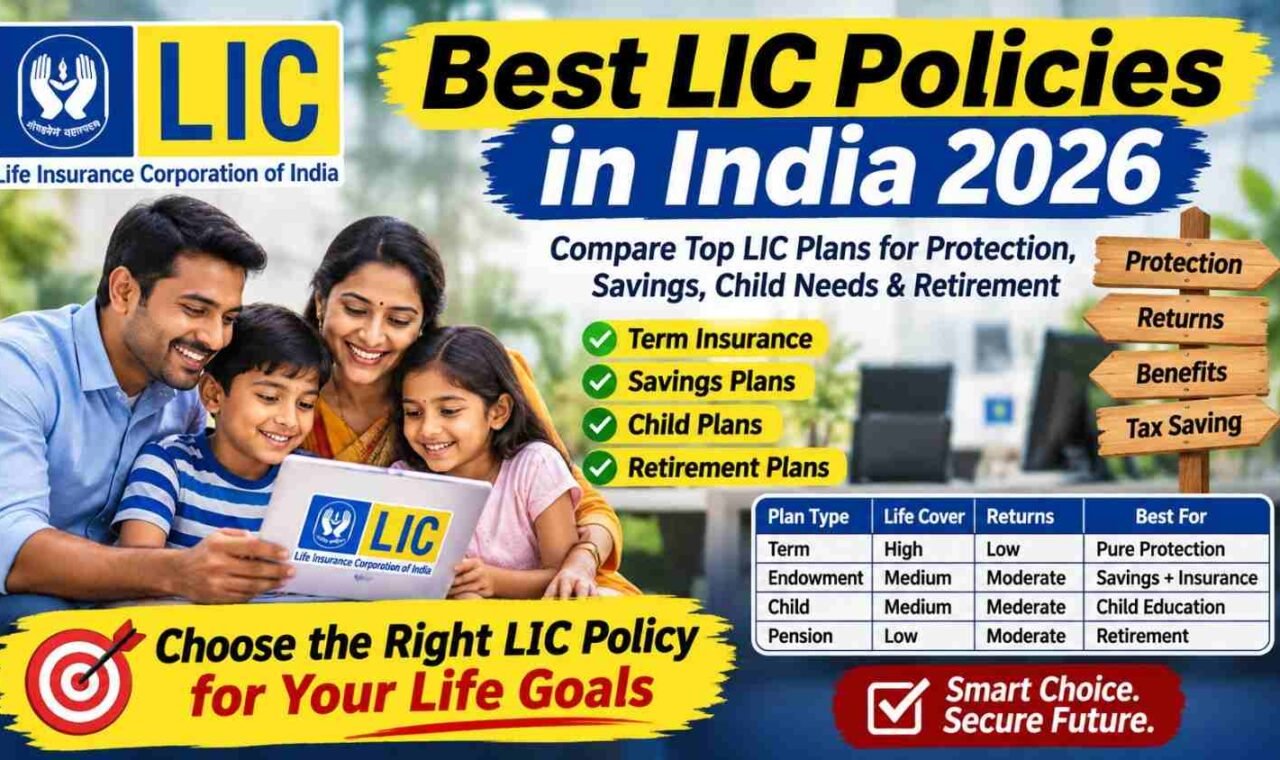
Many people search best LIC policies in India thinking one plan will fit everybody. It not work like that.
A policy good for your father may be wrong for you. Your age matters. Salary matters. Loans, children, parents depending on you, future money needs—all change the answer.
First thing I always see is one confusion: insurance and investment are not same job. Insurance mainly protects family when income person is gone. Investment mainly tries to grow money. Some LIC plans mix both, but we should check what we actually need before seeing maturity amount.
You may be looking for:
- Family protection
- Long-term savings
- Child education planning
- Retirement money
- Guaranteed or lifelong income
LIC has term, endowment, whole-life, child, pension, annuity and other plans. So, which is the best LIC policy in India in 2026? No one answer.
Here we compare plans using official LIC product details, not only big maturity figures shown during selling.
Information verified/updated: 2026.
Quick Answer: Best LIC Policy by Goal
People ask me, “Which is the best LIC policy in India?” But I cannot put one plan name for every person. Your need comes first. A young parent wanting ₹1 crore protection and a retired person wanting monthly income are standing in two different roads.
| Your goal | LIC plans worth checking | Look closely at |
|---|---|---|
| Maximum family protection | Digi Term, Yuva Term, New Tech-Term, New Jeevan Amar, Bima Kavach | Big life cover, affordable premium |
| Savings + insurance | New Jeevan Anand, Jeevan Labh, Jeevan Lakshya | Death benefit, IRR, guarantees |
| Whole-life/income | Jeevan Umang, Jeevan Utsav | Income pattern, long-term benefit |
| Child planning | Jeevan Tarun, New Children’s Money Back, Jeevan Lakshya | Money timing, parent protection |
| Retirement | Jeevan Akshay-VII, New Jeevan Shanti, Smart Pension | Guaranteed income, inflation |
| Women-specific need | Bima Lakshmi and suitable regular LIC plans | Actual coverage need |
| Tax planning | Eligible LIC plans | Tax rule first, policy need next |
These plans are in LIC’s current product lists in 2026.
Now one common mistake. Highest maturity money does not always mean highest return. Jeevan Labh or Jeevan Anand may give savings plus life cover, while term plans normally give much bigger life cover for lower premium. Bonus also cannot be called “highest” without checking plan terms and future declarations.
If you want guaranteed retirement cash flow, LIC currently lists annuity choices such as New Jeevan Shanti and Jeevan Akshay-VII, where stated annuity rates are guaranteed from start.
So I would not ask, “Which LIC plan is best?” first. I ask, “What money problem should this policy solve for your family?”
Before Choosing a Policy: Protection, Investment or Both?
Before seeing best LIC policies in India, I feel one question comes first. What you actually want from this policy? Protection? Saving money? Or you are expecting both together.
This small question changes almost everything.
Pure Protection
Term insurance is mainly for one hard thing. If you die during policy period, family should not fall into money problem.
LIC currently has separate term assurance plans such as Digi Term, Yuva Term and New Tech-Term. LIC’s Digi Term brochure clearly says no maturity benefit is payable when insured person survives till policy end.
Many people ask me, “Then my premium is wasted?”
I don’t see it that way. We pay for risk cover. Like we don’t wish house fire just because we paid home insurance.
Term plans can give much higher death cover for comparatively lower premium because insurer is mostly covering death risk. There is no big saving amount being built for maturity.
Insurance + Savings
Endowment, money-back and whole-life policies work different. Part of reason you pay more is these plans may carry maturity, survival or long-term policy benefits. LIC itself keeps term, endowment, money-back and whole-life products as separate plan categories.
Here is where people sometimes get surprised.
You may pay much bigger premium, yet death cover can be far smaller than pure term insurance.
That is not automatically bad. But know what you buying.
What About Investment?
I would first ask: Is my family protected enough?
Only after that I look at saving and wealth building.
A term insurance + mutual fund SIP and an LIC endowment policy are not same products. One separates insurance and investment. Other joins both inside one contract. Each has own risk, return, discipline and liquidity.
So don’t start by asking, “Which LIC gives highest return?”
Start here:
First insure the financial risk; then decide how you want to save or invest.
How Much LIC Life Cover Do You Actually Need?
₹50 lakh sounds big. ₹1 crore sounds more safe. But this is not the right way to choose LIC life cover.
Your family need is the real number.
I usually think like this. If your income suddenly stop tomorrow, how many years your family can run without you? Rent, food, school fees, home loan, parents, children education, even future marriage plans. All these keep coming.
A simple way is:
Required cover ≈ family income requirement + liabilities + major future goals − available financial assets.
Some people use 10×, 15× or 20× annual income as a quick Human Life Value idea. Useful for starting, not final answer.
Say you earn ₹50,000 monthly, or ₹6 lakh yearly. A rough 15× number becomes ₹90 lakh. But if you already have ₹20 lakh savings and no loan, need may fall. If ₹40 lakh home loan and two young children are there, ₹1 crore may even feel short.
Same with ₹1 lakh monthly salary. Don’t blindly say ₹1 crore or ₹2 crore. Count remaining working years, spouse income, existing LIC or other insurance, investments and emergency reserves.
Yes, include home loan and personal or business debts.
Employer life insurance? I would not fully depend on it. Job can change.
Husband and wife may both need cover when family depends on both incomes.
Even a homemaker creates financial value. Child care, home work and daily support will cost money to replace.
And “Can ₹1 crore LIC cover cost ₹1,000 per month?” Maybe for some profile, maybe not. Age, health, smoking, term and plan decides premium.
First calculate need. Then shop for policy.
Best LIC Term Insurance Plans for Maximum Protection
When I look term insurance, I keep one thought first — how much money family gets if earning person is not there tomorrow? Not maturity money. Not bonus.
LIC currently lists Digi Term, Yuva Term, New Tech-Term, New Jeevan Amar, Saral Jeevan Bima and Bima Kavach among its term assurance plans.
| Plan | What I notice | Better suited for |
|---|---|---|
| LIC Digi Term | Online only, age 18–45, minimum cover ₹50 lakh | Younger online buyers |
| LIC Yuva Term | Offline distribution, age 18–45, minimum ₹50 lakh | People wanting agent help |
| New Tech-Term | Online only, entry up to 65, minimum ₹50 lakh | Wider-age digital buyers |
| New Jeevan Amar | Offline pure-risk plan | Buyers wanting assisted purchase |
| Bima Kavach | Pure-risk protection with death-benefit choices | People wanting newer LIC protection options |
| Saral Jeevan Bima | Simpler standardized term cover | People needing simpler protection |
Digi Term becomes interesting for ₹1 crore LIC policy search. It allows level or increasing cover, single/regular/limited premium, and policy terms that can go up to 40 years depending on conditions. There is no maturity benefit. So if you survive, don’t expect investment return. This is protection money.
Yuva Term looks close, but one practical difference is buying route. It is available through licensed agents and other intermediaries, while Digi Term is online only. Both currently start from ₹50 lakh basic sum assured.
New Tech-Term gives another useful choice. Entry can go up to 65 years, maturity up to 80, and there is no fixed maximum sum assured, though LIC underwriting decides it. Level and increasing cover are available.
I would not call the cheapest premium the best LIC term insurance in 2026. Your smoking status, health, age, ₹1 crore requirement, policy years and underwriting can change premium greatly. Compare LIC with private insurers too. First see cover, policy wording, exclusions and claim conditions. Price comes after that.
Best LIC Savings & Endowment Policies
When people ask me best LIC policy for long-term savings, first thing I feel is little problem in question itself. Big maturity number look nice. ₹20 lakh, ₹30 lakh, maybe more. But your money is going for 15 or 20 years. So I want know one simple thing: what return my money actually made?
LIC currently lists New Jeevan Anand, Jeevan Labh, Jeevan Lakshya, New Endowment, Bima Jyoti, Amritbaal, Nav Jeevan Shree, Bima Lakshmi and New Jeevan Sathi variants under its endowment plans.
Here I compare them more like this:
| Plan | I would look at it for |
|---|---|
| New Jeevan Anand | Savings with life cover continuing beyond maturity |
| Jeevan Labh | Limited premium payment with long savings period |
| Jeevan Lakshya | Family/child goal planning |
| New Endowment | Simple insurance plus savings structure |
| Bima Jyoti | Guaranteed-addition style savings |
| Amritbaal | Child-focused future saving |
| Nav Jeevan Shree | Savings choice including single-premium route |
| Bima Lakshmi | Women-focused savings needs |
| New Jeevan Sathi | Joint-life savings for married couple |
But table is only beginning.
Jeevan Anand vs Jeevan Labh? I would not pick from maturity figure. Check premium-paying years, death cover, bonus assumption, loan, surrender value and then calculate approximate IRR. LIC still lists Jeevan Labh as Plan 736, with its current brochure applicable from September 22, 2025 onward.
Jeevan Umang is different thought again. It sits under whole-life plans, not regular endowment list. So Jeevan Anand vs Jeevan Umang or Jeevan Labh vs Jeevan Umang is really savings-at-maturity versus longer life-cover/income need comparison.
For one-time premium seekers, New Jeevan Sathi Single Premium became available June 1, 2026. It covers both spouses under one policy, gives guaranteed additions, maturity benefit and loan facility. Its Limited Premium version allows 5, 10 or 15-year premium terms depending on policy term.
My rule is boring, but useful: don’t ask only “how much I get?” Ask “what IRR I get, what cover I get, and what happens if I need money early?”
And if your real need is very high life cover, compare these savings plans with term insurance before choosing. That one comparison can change whole decision.
Guaranteed Return, Bonus and IRR: What “Returns” Really Mean
When I first see an LIC policy benefit table, I don’t look at the big maturity number first. That number can pull our eyes fast. I look below it. What part is sure? What part may come later? This small check can save you from buying with wrong hope.
The Basic Sum Assured is the base amount written in the policy. But Sum Assured on Death can be calculated differently depending on the plan. Sum Assured on Maturity is again another thing. Same words around “sum assured,” but not always same money.
This is where many buyers get confused.
A guaranteed benefit is written as guaranteed under policy rules. Non-guaranteed benefit depends on future declaration or performance. LIC’s Jeevan Labh brochure itself says guaranteed benefits are clearly marked as “guaranteed” in the benefit illustration.
A participating plan can share declared surplus through bonus. A non-participating plan does not work this way. For example, LIC describes Jeevan Utsav as non-participating.
Then comes bonus. Simple Reversionary Bonus may be declared yearly in eligible participating plans. In New Jeevan Anand, LIC says once such bonus is declared, it becomes part of guaranteed benefits. But future bonus is not already guaranteed. Final Additional Bonus, if any, may come at death or maturity depending on plan rules.
So, does LIC bonus compound? Do not simply assume yes. Read how bonus is attached and paid under that exact plan.
Also, an agent saying “you may get ₹X lakh” does not make ₹X lakh guaranteed.
For money-back plans, some money may come during policy years as survival benefits, then maturity benefits later. This changes your real return calculation.
I use one simple method:
Premium dates → money going out → guaranteed and possible money coming in → IRR/XIRR → inflation check.
IRR shows annual return. XIRR is better when premium and benefit dates are not equal gaps.
So, which LIC policy gives highest return? There is no safe answer from maturity amount alone. A guaranteed-income plan may give more certainty, while another plan may show higher possible value but with non-guaranteed parts.
That difference matters. A lot.
Inflation Test: Is ₹50 Lakh After 25 Years Really ₹50 Lakh?
₹50 lakh sounds big today. After 25 years, maybe not that big.
This is where inflation quietly eats your money value. Prices keep going up. School fees, hospital cost, house rent, food, everything. So ₹50 lakh received many years later cannot buy what ₹50 lakh can buy today.
I always feel maturity amount alone can fool us little bit. We see one large number on LIC illustration and mind says, “good money.” But real question should be: what is its present value?
Suppose your policy gives ₹50 lakh after 25 years. You need check its real return after inflation, not only total maturity money.
This matters more for:
- Child education, because college cost may become much higher.
- Retirement, where money must last many years.
- Long-duration endowment plans.
- Guaranteed-income plans where income may stay fixed.
So when comparing the best LIC policies in India, don’t ask only, “How much I get?” Ask, “What can this money actually buy when I receive it?”
Best LIC Plans by Age, Occupation and Family Situation
I don’t think one LIC plan can be called best for everybody. A 25-year-old with no loan is standing in one place. A 45-year-old father paying home EMI is standing somewhere very different. So before looking at policy name, I would ask four simple things: Who depends on your income? For how many years? What debts are sitting on you? What money goal are you trying to finish?
Best LIC Policy by Age
At 25: protection usually deserves first attention. You have many earning years ahead, so a term plan such as LIC Digi Term, Yuva Term or New Tech-Term may be worth comparing for large life cover. LIC currently lists these among its active term assurance plans.
At 30: marriage, children and home loan may start coming together. I would first fix enough term cover, then only look at savings plans if money is still comfortably left.
At 35: this age can feel heavy. School fees are coming, EMI is running, parents may need help. Here, low life cover is a bigger problem than missing one savings policy.
After 40: check remaining working years carefully. Buying a long policy just because agent says “good return” may not match your real goal.
After 50: protection need may slowly reduce if loans are low and children are independent. Retirement income becomes more important.
Senior citizens: pension and annuity plans can be more relevant than large new life cover. LIC itself places pension plans around retirement and senior-citizen needs.
Best LIC Policy by Profession
Salaried employee: cover salary loss first. Employer insurance may disappear when job changes.
Government employee: stable job does not mean no insurance need. Family dependency, loans and retirement gap still matter.
Business owner/self-employed: income can go up and down. I would avoid a premium so big that one weak business year makes policy painful.
Best LIC Policy by Family Situation
Newly married: ask, “If I die next year, can my spouse handle rent, EMI and daily life?”
Parents and single-income families: usually need stronger income protection because one earning person carries more load.
Women and homemakers: do not ignore their financial value. Child care and home work also cost real money to replace.
NRIs: LIC allows NRI insurance subject to specific conditions, including where proposal formalities happen and some restrictions on term cover. LIC’s NRI guidance was updated on July 16, 2026.
Low-income families: keep premium simple and affordable. Insurance should not make monthly life harder.
High-income households: bigger income does not automatically mean expensive savings policy. First check liabilities, dependants, estate needs and existing assets.
In the end, I would not ask, “Which LIC policy is best for my age?” I would ask, “What damage happens to my family if my income stops, and which policy solves that problem without hurting today’s cash flow?”
Best LIC Policies for Children and Education
When parents ask me “Which is the best LIC policy for my child?”, I feel one thing get missed many times. Policy name comes first. Child education cost comes later. I would do opposite.
First write the money your child may need. College at 18? Higher study at 21? Marriage later? Then count years left. After this only look at LIC plan.
LIC currently lists Jeevan Tarun, New Children’s Money Back Plan and Amritbaal under its child-future plans. Jeevan Lakshya is also worth checking when parent protection and future savings both matter.
| Need | Plan worth checking |
|---|---|
| Education money in stages | Jeevan Tarun |
| Money-back at growing ages | New Children’s Money Back |
| Parent protection + savings | Jeevan Lakshya |
| Child-focused guaranteed savings | Amritbaal |
Jeevan Tarun vs Children’s Money Back? Jeevan Tarun mixes protection and savings for children, while New Children’s Money Back is specially built around survival benefits for education, marriage and other growing-child needs.
For a newborn or girl child, I would not say LIC automatically wins. Compare it with Sukanya Samriddhi Yojana, PPF and mutual fund SIP too. One gives insurance features, another may give government-backed savings, another may aim for market growth. They solve different job.
This part is very important. If parent dies early, child goal should not die with him or her. Check whether premium-waiver rider is available, who is insured, when risk cover starts, and whether future benefits continue after death.
My simple rule: first calculate education corpus, then choose product. Never buy ₹10 lakh future plan only because today ₹10 lakh looks big. Inflation quietly changes that number.
Best LIC Policies for Retirement, Pension and Monthly Income
Retirement money looks simple until salary stops. Then every ₹1,000 feels different. I have seen many people asking, “Which is best LIC retirement policy?” But first question should be—do you need growth now, or fixed money after retirement?
LIC currently lists pension plans like Jeevan Akshay-VII, New Jeevan Shanti, Saral Pension, Smart Pension and New Pension Plus. Jeevan Akshay-VII is an immediate annuity plan bought with lump-sum money, while New Jeevan Shanti gives deferred annuity and has Single Life and Joint Life choices. Joint-life option can matter when husband and wife both depend on same retirement money.
For people searching LIC monthly income plans or pension after 60, annuity can give peace. Money keeps coming for life. Some options may return purchase price after death, depending on annuity choice. But this comfort has another side. Your money becomes less liquid.
Then inflation comes quietly.
A fixed ₹30,000 pension may feel fine today. After many years, food, hospital and house expenses can become bigger. So guaranteed income is not same as guaranteed purchasing power.
LIC Jeevan Umang and Jeevan Utsav are whole-life plans, not normal pension plans. Jeevan Utsav provides Regular Income or Flexi Income benefits with lifetime risk cover.
I would not keep all retirement money in one basket.
| Option | Main use |
|---|---|
| LIC annuity | Lifelong predictable income |
| NPS | Market-linked retirement growth |
| SCSS | Senior-citizen income |
| FD | Simple fixed income |
| PPF | Long-term tax-efficient saving |
NPS is market-linked and regulated by PFRDA, so returns can move. SCSS currently shows 8.2% annual interest on India Post.
For me, good retirement plan means not highest pension only. Check spouse benefit, liquidity, tax, inflation, return of purchase price and how long income must survive. Your pension should live as long as you do.
LIC vs Mutual Funds, PPF, FD, NPS and SSY: Same Money, Different Work
I used to look at these choices with one question: which gives more return? That question itself can take us wrong place.
LIC vs mutual fund SIP is not clean fight. LIC has term plans mainly for life cover, while mutual fund SIP is investment route. LIC also has endowment plans where insurance and saving sit together.
Think what your money need to do first.
| Option | Main job | Risk/Liquidity |
|---|---|---|
| LIC | Protection + saving, based on plan | Usually long commitment |
| Mutual fund | Wealth growth | Market moves |
| PPF | Long safe saving | Low liquidity |
| FD | Fixed saving | Easier access |
| NPS | Retirement | Market-linked, restrictions |
| SSY | Girl-child saving | Long-term goal |
PPF currently gives 7.1% a year, compounded yearly. Sukanya Samriddhi is 8.2% up to September 30, 2026. NPS is market-linked and mainly built for retirement saving.
So LIC vs PPF, LIC vs FD, LIC vs NPS, or LIC vs Sukanya Samriddhi depends on goal, tax, lock-in, guarantee and when you need money.
I also don’t compare LIC guaranteed plan vs equity mutual fund only by return. One may give certainty; other accepts market ups and downs for growth chance.
Same with money-back vs endowment, single-premium vs regular-premium, and term insurance + SIP vs endowment.
My simple way: first protect family, then grow money.
An investment giving better return still cannot replace life insurance when your family actually needs life cover.
LIC vs Private Insurers: Does “LIC Is Safer” Settle the Question?
At my home also I heard this many times: “LIC is government, so just take LIC.” Trust is important. But your family need right policy also.
LIC is huge. In FY 2025–26, it held 56.66% overall premium market share and sold about 1.84 crore individual policies. Its death claim settlement ratio was 99.44%. By June 30, 2026, LIC reported ₹59.39 lakh crore AUM and solvency ratio 2.42.
Still, LIC vs HDFC Life, ICICI Prudential, Axis Max Life or SBI Life cannot finish there.
Private insurers also report strong numbers. HDFC Life reported 99.72% claim settlement for FY2025–26, while ICICI Prudential reported 99.34%.
When checking LIC term vs private term plans, I look deeper:
- Premium for same cover.
- Policy wording and exclusions.
- Medical underwriting.
- Claim steps.
- Riders.
- Online service.
- Agent help.
- Financial strength.
This matters with LIC Digi Term vs private insurers too. Cheap premium alone not winner. Big brand also not winner.
And claim ratio? Useful, yes. But your own claim depends on policy terms, correct disclosure and claim facts. A 99%+ company ratio cannot promise your individual claim will pass.
Biggest LIC Buying Mistakes Real Policyholders Report
Some LIC mistakes start in a very normal place. Uncle knows an agent. Father trusts LIC from 30 years. Friend says, “Just take this plan, safe one.” We sign. Later only we open policy paper properly.
I saw one recent Jeevan Labh policyholder experience where the person finally surrendered the policy after feeling insurance and investment got mixed badly for his need. Another person paying ₹90,000 yearly was trying to understand why the surrender amount looked so low. These are personal experiences, not proof that every LIC policyholder faces same result.
The mistakes usually come like this:
- Paying high premium and thinking this means high life protection.
- Seeing ₹40 lakh or ₹50 lakh future maturity, but never checking IRR or inflation.
- Hearing “bonus” and understanding it like guaranteed money.
- Buying money-back because money comes in between, without checking whether it really fits your goal.
- Taking policy mainly for tax saving.
- Putting emergency money into a 20-year type commitment.
- Buying small death cover when family actually needs much bigger protection.
- Forgetting nominee changes.
- Hiding smoking or health details because premium may increase.
- Adding riders without knowing what they really cover.
Family pressure is real also. One recent discussion came from a working person whose parents strongly wanted a traditional LIC policy because they saw LIC as the safe choice. Older discussions show same fear about private insurers, while other buyers go opposite side and choose private term insurance only because premium looks cheaper.
Both shortcuts can hurt.
Before buying Digi Term, Tech-Term, Jeevan Labh, money-back or any plan, I would write three things on paper: How much death cover I need? What return may actually come? Can I keep paying this premium even in bad year?
That small check can save a very long regret.
Bought the Wrong LIC Policy? Continue vs Paid-Up vs Surrender vs Loan
Do not stop premiums blindly. First compare four options.
I have seen people get angry after 3 or 4 years. Premium feels heavy now. Agent told one maturity number, later it not looking so great. Then first thought comes, “Should I surrender my LIC policy?”
Maybe. But not always.
Continue
Check how much premium still left, what death cover you get, and what future benefit may come. If policy still matching your goal and premium is easy for you, continuing can make sense.
Paid-Up
Sometimes you can stop future premiums and keep a smaller benefit. This is called paid-up policy. Your cover and maturity value normally become lower. It may suit someone who cannot keep paying but also does not want immediate surrender.
Surrender
Here many people get shock.
LIC says surrender value depends on policy conditions, and early exit can give much less money than what you paid. Older general LIC guidance mentions surrender eligibility after required premiums, but today you must check your own policy document, because rules differ by plan.
So, why is surrender value so low? Insurance cost, policy design, surrender factors, bonus rules and timing all matter.
Policy Loan
Need money for hospital bill, job gap, or family emergency? Before breaking policy, check loan option. Some LIC policies allow loan after conditions are met. Loan amount is not same for every plan.
My simple recovery method is this:
- Premium too costly → compare continue, paid-up, surrender and loan.
- Life cover too small → keep this decision separate and check extra term cover.
- Maturity was over-promised → recalculate from official benefit illustration.
- Temporary cash problem → check policy loan before surrender.
And if policy already lapsed, don’t just revive because someone says so. First compare revival cost with future value. LIC currently provides revival forms and servicing support, but revival terms remain policy-specific.
Regret is emotional. Exit decision should be numbers.
Lapsed LIC Policy: Revival and Recovery Steps
Missed one LIC premium? Many people get scared here. I also seen people thinking, “policy gone, all money lost.” Not always.
LIC says if premium is not paid inside the grace period, policy can lapse. For monthly premium, LIC generally gives 15 days grace; for quarterly, half-yearly and yearly modes, it is usually one month, but not less than 30 days.
A lapsed LIC policy can often be revived, but exact revival period depend on your plan. Some current LIC plans allow revival up to 5 consecutive complete years from first unpaid premium.
Do this first:
- Check your present policy status online.
- Ask LIC for revival amount.
- See unpaid premiums plus revival interest/cost.
- Check whether fresh health proof or medical requirement comes.
- Compare revival with paid-up or surrender, if your policy allows them.
This last part matters. Revival is possible, but possible does not always mean good money decision.
Maybe your income changed. Maybe cover is too small now. Maybe many premiums still left.
So don’t revive only because old money already paid.
First ask: Does this LIC policy still solve my family need today?
Then revive, continue, paid-up, or surrender with clear numbers—not fear.
Claims, Nomination and Policy Servicing: Will Your Family Actually Get the Money?
We buy policy for family. But one small old nominee name, wrong bank account, missing bond… later family run here and there. I don’t like this part being ignored.
First check nomination. LIC says nominee can be changed during policy life, and change should be registered with the servicing branch. After marriage, divorce, childbirth, or family change, look at it again.
For maturity also, keep bank account and NEFT details correct. LIC generally sends maturity intimation around two months before due date and asks for discharge form, policy document, NEFT/bank proof and other required records.
Policy bond lost? Don’t panic and don’t simply assume claim is gone. LIC provides a duplicate-policy process and related forms.
For a death claim, family normally informs the servicing branch and submits claim form, death proof, policy document and any extra records LIC asks based on the case.
People ask, “Can nominee claim without original bond?” When bond missing, contact branch first and follow duplicate/document requirements. Don’t wait until claim day.
Claim getting delayed? Keep copies, dates, receipts, complaint number. Start with LIC grievance system. If issue stays unresolved, escalation can go through IRDAI grievance channels and eligible disputes may reach the Insurance Ombudsman, including claim-delay and policy-servicing complaints.
My simple rule: once yearly, check nominee, bank, NEFT, phone, address and policy papers. Insurance money should reach family, not become another problem.
Taxation: Is LIC Still Worth Buying Just for Tax Saving?
I would not buy LIC only because March came and tax saving tension started.
Under the old tax regime, eligible life insurance premium can come under Section 80C, inside the combined ₹1.5 lakh deduction limit. But under the new tax regime, normal Section 80C deduction is not available. So, does LIC still make sense under new tax regime? Yes, maybe for insurance need. Not just for getting 80C.
Then another doubt comes. Are LIC maturity proceeds tax-free?
Not every policy automatically.
Section 10(10D) can exempt eligible life insurance proceeds, including bonus, but conditions and exclusions apply depending on policy type, premium level and issue date. Death benefits also have separate protection under the tax rules.
So which LIC policy is best for tax saving? Wrong first question, I feel.
First see:
- Do you need this insurance?
- Can you pay premium for many years?
- Is maturity eligible for tax exemption?
- Which tax regime you use?
A 15, 20 or 30-year insurance promise should never be taken only to save one year tax. Tax law can change. Your family need comes first, tax benefit can stay as extra.
35-Step LIC Buying Checklist: Do This Before You Pay Premium
Buying LIC policy can feel simple when somebody says, “Good plan, pay this much, you get this much later.” I don’t like deciding that fast. This money may go for 10, 20, even more years. So I check small things first.
Use this LIC buying checklist before signing.
- Decide why you need policy.
- Write who depends on your income.
- Calculate life cover your family really need.
- Add home loan and other debts.
- Add child education, marriage and family goals.
- Minus savings and investments already available.
- Check existing insurance cover.
- Choose term insurance or insurance-plus-savings.
- Shortlist only LIC plans selling now.
- Verify plan number and UIN.
- Read official LIC brochure yourself.
- Check entry age.
- See policy term.
- See how many years premium must pay.
- Confirm sum assured.
- Read death benefit carefully.
- Check maturity benefit.
- Find any survival benefit.
- Mark what money is guaranteed.
- Mark what money is not guaranteed.
- Don’t treat future bonus assumption as fixed money.
- Calculate rough IRR/XIRR.
- Think what maturity money worth after inflation.
- Check surrender rules.
- Ask what happens if policy become paid-up.
- See whether policy loan is available.
- Read riders, not just their names.
- Check exclusions.
- Understand medical test and underwriting.
- Ask yourself, “Can I pay this premium even in bad year?”
- Keep emergency money outside policy.
- Tell smoking and health details correctly.
- Put correct nominee.
- Read benefit illustration and free-look terms. IRDAI says life policies have a free-look facility, so use it to review what you received.
- Keep policy papers where your family can find them.
One more thing I do: I compare the brochure with what agent told me. LIC has many different products and conditions; one promise cannot fit every policy.
A good LIC policy is not the one with biggest maturity number on paper. It is one you understand, can afford, and your family can actually use when the need comes.
Questions to Ask an LIC Agent Before Paying
Before you pay first premium, slow down little. Agent may show one big maturity number. It looks nice. But your money may stay there for many years, so ask hard questions now, not after regret.
Ask this clearly:
- Is this benefit guaranteed, or only expected?
- Which maturity amount is only projection?
- What exact death cover my family gets?
- What may be the IRR, not just total maturity money?
- If I stop premium, what happens?
- What is surrender value after 3, 5 and 10 years?
- If policy becomes paid-up, how much benefit remains?
- Can I take loan from this policy?
- Which riders cost extra?
- What exclusions can stop or reduce claim?
- Which assumptions used to show this maturity amount?
- What would same death cover cost in a pure term plan?
- What is the policy UIN?
- Can you show official LIC benefit illustration?
- If I surrender early, how much money may I lose?
- If I die while still paying premiums, what exactly family receives?
I would not accept only “don’t worry, LIC is safe.” Safety is one thing. A suitable policy is another.
Take the illustration home. Read numbers slowly. Compare cover, premium, surrender, guarantee and return. If agent cannot explain a simple question in simple words, I would not pay that day.
Current LIC 2026 Data: Big Numbers, But What They Really Tell You
Before calling any plan the best LIC policy in India, I like seeing company numbers once. Not because big number means best policy. It don’t.
For FY2025–26, LIC sold 1,84,41,175 individual policies, up 3.70% from previous year. Its overall life insurance market share by First Year Premium Income was 56.66%.
Some more numbers caught my eye.
- Death claim settlement ratio: 99.44%.
- Solvency ratio: 2.35 on March 31, 2026.
- Assets under management: ₹57,29,396 crore.
- Bonus allocated to policyholders: ₹59,726 crore for FY2025–26.
- Individual Non-Par APE share: moved from 27.69% to 35.11%, while Non-Par APE grew 43.78%.
- LIC reported 58 offerings as on March 31, 2026.
These tell me LIC is huge, financially strong looking, and selling many policies. But wait.
A 99.44% claim settlement ratio does not mean your claim gets automatic approval. Policy terms, disclosure, documents and claim facts still matter.
Same with ₹57 lakh-crore AUM. Impressive company size, yes. It cannot tell whether Jeevan Labh, Digi Term, Jeevan Utsav, or another plan fits your family.
Use LIC 2026 data for trust check. Then use coverage, premium, return, lock-in and your goal for actual policy choice.
Who Should Consider Which LIC Category?
Many people ask, “Which LIC policy is best?” I feel that question is little wrong. First ask, what problem I am trying to solve?
If your family depends on your salary, term insurance may come first. You need big life cover, but premium should not hurt monthly home budget. Here protection is main work. Not maturity.
Endowment or savings LIC plans may suit you when you like forced saving, some guarantee, and long holding. But please see expected return clearly. If premium is so high that you cannot buy enough life cover, something is not matching.
For child plans, timing matters a lot. Education money should come near the year your child actually needs college money. Also see what happens if parent dies during policy years.
Pension or income plans can suit a person who says, “I want regular money after retirement, I don’t want too much market tension.” But more fixed income can mean less growth or less easy access to money.
Think again before buying
- No emergency fund yet.
- Buying only to save tax.
- You don’t know which benefit is guaranteed.
- Agent showed future amount, but you cannot explain how it came.
- Your family still has very low life cover.
For me, LIC category choice becomes simple when we put need first, product second. Not because one plan is popular.
Frequently Asked Questions
1. Which is the best LIC policy in India?
No single LIC policy is best for everybody. Your age, income, family needs, loans, savings goal and retirement plan changes the answer. LIC itself groups products by different financial needs.
2. Which LIC policy gives the highest return?
I would not pick policy only seeing maturity money. Check guaranteed benefit, bonus, premium years, IRR and inflation. Bigger maturity amount does not always mean better real return.
3. Which LIC policy is best for ₹1 crore cover?
For large life cover, start checking pure term plans. LIC currently lists Digi Term, Yuva Term, Bima Kavach and other term products.
4. Which LIC policy is best for a 30-year-old?
At 30, I first look at dependants, income and debt. If family depends on your salary, strong term cover may need attention before savings plans.
5. Which LIC policy is best for women?
There is no one women-only answer. A woman earning income, homemaker, mother or business owner can have very different protection and saving needs.
6. Which LIC policy is best for children?
For child goals, compare plans made for education and future needs. LIC’s New Children’s Money Back Plan is designed around child financial needs.
7. Which LIC policy is best for retirement?
Retirement needs different thinking. Check pension or annuity choices based on income need, liquidity, spouse needs, tax and inflation—not only the promised yearly payment.
8. Which LIC plan gives monthly income?
Some pension, annuity or income-style products can provide regular payouts. But payout frequency and conditions differ, so read current LIC policy brochure before choosing.
9. Which LIC policy is best for tax saving?
Eligible life insurance premiums may get tax treatment under Section 80C, while maturity taxation depends on Section 10(10D) conditions. Tax alone should not decide your policy.
10. Is LIC better than private insurance?
Not automatically. Compare premium, cover, exclusions, underwriting, service and policy wording. Brand trust is useful, but your actual insurance need matters more.
11. LIC term insurance or Jeevan Anand?
Term insurance mainly protects family. Jeevan Anand combines insurance with savings features. These are different tools, so comparing only maturity value can confuse you.
12. LIC or mutual funds—which is better?
LIC can provide life insurance. Mutual funds are investments. I would first decide whether your problem is protection or wealth building, then compare suitable products.
13. Can I surrender an LIC policy?
Yes, where policy conditions allow surrender. But surrender value can be much lower than expected, especially earlier. Check official policy terms before stopping premiums.
14. Surrender or make policy paid-up?
Do some maths first. Compare surrender money now with reduced paid-up benefits later, remaining premiums, insurance cover and your current cash problem.
15. Can a lapsed LIC policy be revived?
Many LIC policies provide revival conditions. Cost, time limits and possible health requirements depend on the policy, so check your exact contract.
16. Are LIC bonuses guaranteed?
No, not every bonus should be treated as guaranteed. LIC explains that some bonus payments depend on policy type and declared benefits.
17. Does LIC offer policy loans?
Certain LIC policies provide loan facility, not every policy. Loan amount and interest depend on policy conditions and available value.
18. Is ₹1 crore term insurance enough?
Maybe, maybe not. I would calculate income replacement, loans, children’s goals, dependants and existing assets before calling ₹1 crore enough.
19. Is LIC claim settlement guaranteed?
No insurance claim should be called automatically guaranteed. Claim payment depends on policy terms, disclosures and required documents. LIC publishes its claim requirements separately.
20. Should insurance and investment be kept separate?
Often it makes understanding easier. First protect your family properly. Then decide where savings should grow. Mixing both without checking cover and return can become costly.
Final Verdict: How to Find the “Best” LIC Policy for You
There is no one best LIC policy for everybody. Your need decides it, not big plan name.
If family protection is main worry, check term insurance first. Need saving also? Then look at endowment plan, but see IRR, guaranteed money, surrender value, and how easy your money comes back.
For child plan, first calculate future education money. For retirement, monthly income looks nice, but inflation can slowly eat its value.
Already holding LIC policy? Don’t stop suddenly. Compare continue, paid-up, surrender, or loan.
I would never choose only because agent said good return, big bonus, tax saving, or “LIC is trusted.” Read latest LIC brochure, plan details and UIN yourself.
Use this simple path:
Need → Coverage → Affordability → Guarantees → Return → Liquidity → Tax → Policy wording → Decision.
Read Next: Best health policies in India.
Top 10 term insurance plans in India.
Best car insurance policies in India.





One comment