
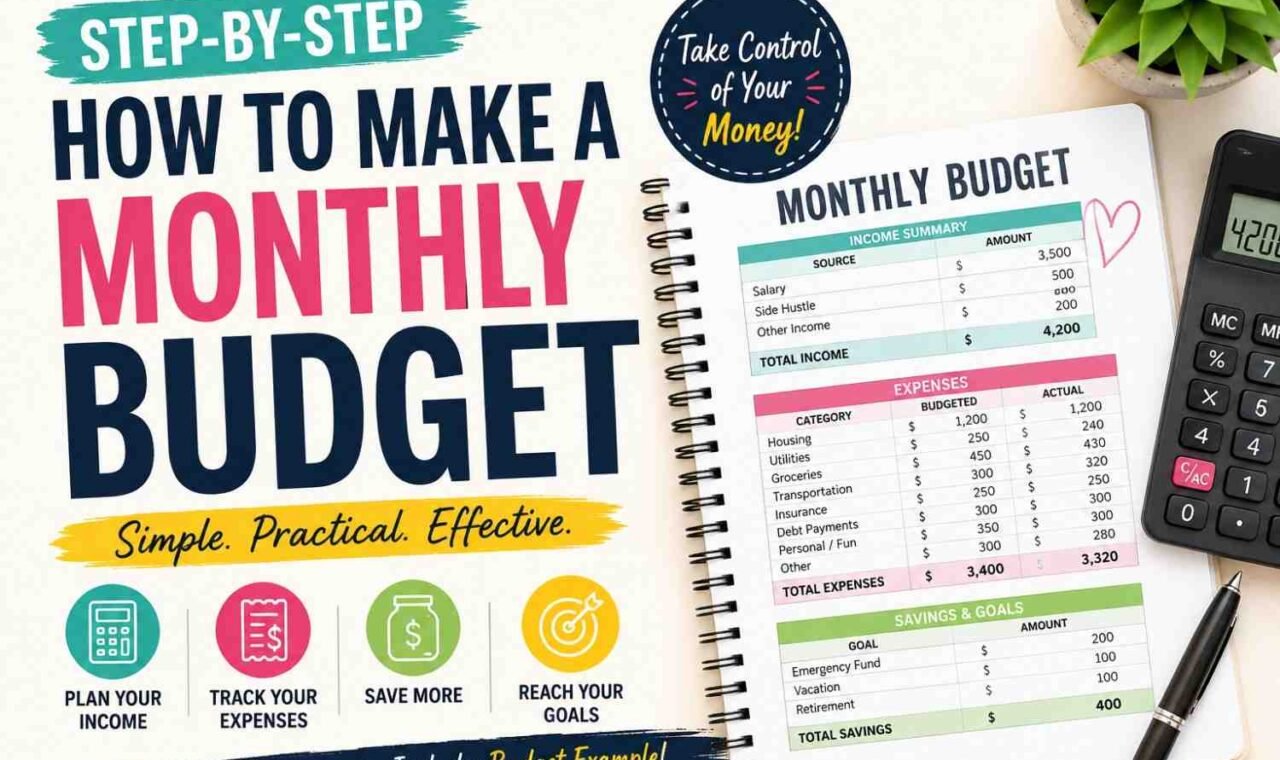
Some month end, you open bank app and one thought come fast: Where did all my money go?
I had this feeling many times. Salary came. Bills paid. Few food orders, fuel, small shopping, maybe one thing for home. Nothing looked too big. Still money became very small before month finished.
This is why a monthly budget help. Not some hard finance lesson. Just a simple plan for your money before money start leaving.
You will see your income, bills, daily spending, savings, and other costs in one place. We also make a real monthly budget example, so you can copy the idea and change numbers for your own life.
By the end, you should have an actual budget you can use this month.
Quick Answer: How Do You Make a Monthly Budget?
To make a monthly budget, first write your take-home income. Then list fixed bills, normal daily expenses, debt payments, savings, and other planned costs. Give each category a limit. Add all planned expenses and compare them with income. During the month, check what you really spend and change the next budget where needed.
Monthly income − planned expenses = amount remaining
If the number is positive, some money still needs a job. Save it, pay debt, or keep part for future costs.
If it becomes negative, your plan is spending more money than you bring home. That is the place where we start fixing things.
What Is a Monthly Budget?
A monthly budget is simple plan for your money before the month starts. You see how much money coming in, then decide where that money should go. Rent, food, bills, saving, debt, small fun also. Everything get some place.
I used to think budget means only writing expenses after I spend. That was my mistake. I was checking bank app and seeing, “Oh, I spent this much.” But money already gone. Nothing I can change there.
This is where budget and expense tracker are different.
| Budget | Expense Tracker |
|---|---|
| Plans money before spending | Shows money after spending |
| Gives limit for each category | Records what already happened |
| Helps control future spending | Helps understand past spending |
Think like this.
An expense tracker tells you, “You spent $300 on eating outside.”
A monthly budget tells you, “This month, I will keep eating outside under $150.”
That small difference changes many things.
When you make a monthly budget, you are giving each part of your income a job. Some money pay house bills. Some stay for groceries. Some go into savings. Maybe little amount kept for surprise costs, because real life never follows perfect plan.
Your budget also does not need to look perfect. First month may be wrong. Grocery amount maybe too small. Fuel cost may be higher. You adjust next month.
That is normal budgeting.
So remember this one idea: an expense tracker shows where your money went. A budget helps decide where your money should go before it disappears.
What You Need Before Creating Your Budget
Before you make a monthly budget, get your money papers first. This part feel boring, I know. Many people skip it. I did same before, then my budget numbers looked nice on paper but not match real life.
You do not need one big file cabinet. Just collect few things for 5 minutes.
Recent Paychecks or Pay Stubs
Start with your take-home pay. Not the big salary number before tax. Look at your recent paycheck or pay stub and see what actually comes into your bank.
If your income changes every month, check more than one paycheck. Use a lower, safer amount when planning.
Bank Statements
Your bank statement show where money really went.
Look at last 1 to 3 months if possible. Rent, food, fuel, small online buys, ATM cash. These small amounts hide easy. I once found three subscriptions this way.
Credit-Card Statements
Do not only check bank account.
Credit-card spending can make your monthly expenses look smaller than they are. Read recent statements. Mark shopping, food, travel, bills, and any repeat charge.
Monthly Bills
Collect your regular bills.
Electricity, internet, phone, rent, insurance, school fees, streaming, and other fixed costs. Some bill changes each month, so use a fair average.
Debt Balances and Payments
Write every debt in one place.
Include credit cards, personal loans, car loans, student loans, or other money you owe. Note current balance, minimum payment, and due date.
Seeing debt can feel heavy. Still, knowing the number is better than guessing it.
Savings and Financial Goals
Now think why you are making this budget.
Maybe emergency fund. Maybe a trip. Maybe debt freedom. Maybe house down payment.
Give each goal a simple amount and time.
5-Minute Budget Preparation Checklist
- [ ] Find recent paychecks or pay stubs
- [ ] Open bank statements
- [ ] Check credit-card statements
- [ ] List monthly bills
- [ ] Write debt balances and minimum payments
- [ ] Note your main savings goals
Once these are ready, creating a monthly budget becomes much easier. You are not guessing now. You are using your real money life.
How to Make a Monthly Budget in 7 Steps
Making a monthly budget looks easy when somebody show one clean sheet with numbers. Real life not like that.
Money comes. Bills take it. Some small payment happen. One food order here, fuel there, some yearly fee suddenly coming. End of month, you may ask, “Where my money went?”
A budget help you see this before money disappear.
You do not need perfect math. You need honest numbers.
Step 1: Calculate Your Monthly Take-Home Income
First, find how much money actually comes into your hand or bank account each month.
Do not use gross income.
Gross income is your pay before tax and other cuts. Net income, or take-home income, is what you really receive after those deductions.
Your monthly income may include:
- Salary from your main job
- Side hustle income
- Freelance work
- Sales commissions
- Rental income
- Other regular income
For example, your salary may say $4,500, but only $3,700 reaches bank after deductions. Build your monthly budget with $3,700, not $4,500.
I see this mistake often. People make budget with the bigger number because it looks nice. Then budget already broken before month even starts.
How to budget with irregular income
Irregular income is harder. Freelancers, small business owners, commission workers, and gig workers know this problem very well.
One month may be $4,200. Next month only $2,900.
Instead of picking one random number, look at your last 6 to 12 months income if you have records.
Write each month’s take-home income. Then find your lower normal month.
Suppose your recent income was:
$3,100, $3,800, $3,400, $4,200, $3,000, $3,700.
You may build the basic budget around $3,000 or $3,100.
Then when a better month comes, extra money can go toward savings, debt, or future low-income months.
This feels little boring. But boring money planning is often safer than exciting guessing.
Step 2: Review Your Current Spending
Now go backward.
Open your bank statements and credit card history for the last 2 to 3 months.
Do not guess groceries. Do not guess fuel. We usually remember the big bill but forget twelve small ones.
Put transactions into simple groups such as food, housing, transport, shopping, subscriptions, debt, medical, and fun.
You may notice things that surprise you.
Maybe you thought dining out is $150. Real number is $310.
Maybe three small subscriptions together cost more than your phone bill.
Historical spending gives you a real starting point. A monthly budget made from real behavior works better than a budget made from what you wish you were doing.
Step 3: List Your Fixed Monthly Expenses
Fixed expenses are bills that stay same, or close to same, each month.
Start with these because they are easier.
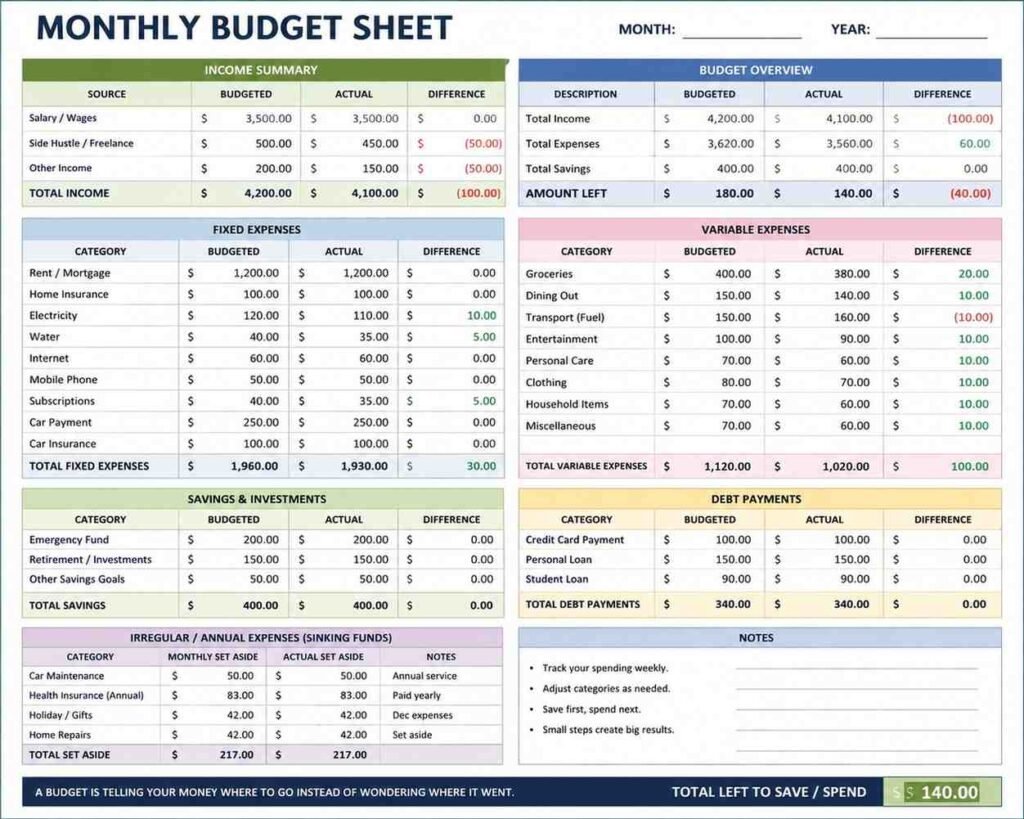
| Fixed expense | Example |
|---|---|
| Housing | Rent or mortgage |
| Insurance | Car, health, home |
| Loan payments | Car loan, personal loan |
| Phone | Mobile plan |
| Internet | Home internet |
| Subscriptions | Streaming, software |
| Childcare | Daycare or school care |
Write the amount beside each one.
Do not leave a subscription just because it is $8 or $12. Small automatic payments are quiet. They keep taking money while nobody thinking about them.
Step 4: Estimate Your Variable Expenses
Variable expenses move up and down.
Groceries may be $420 this month and $510 next month. Gas changes. Eating out changes even faster.
Common variable expenses include:
- Groceries
- Gas
- Dining out
- Entertainment
- Clothing
- Personal care
- Household items
Use the last 2 or 3 months to find a reasonable amount.
Do not suddenly cut groceries from $600 to $250 just because you want a strict budget. Maybe possible, maybe not. Start closer to reality, then improve slowly.
Fixed vs. variable expenses
| Fixed expenses | Variable expenses |
|---|---|
| Usually predictable | Often changes |
| Rent | Groceries |
| Loan payment | Fuel |
| Internet | Dining out |
| Insurance | Clothing |
| Childcare | Entertainment |
This difference matters because variable spending is usually first place we can adjust when money becomes tight.
Step 5: Account for Irregular and Annual Expenses
This part get forgotten. Then later people say, “My budget failed.”
Maybe budget did not fail. The yearly bill was simply missing.
Think about car service, school fees, holidays, annual insurance, gifts, personal finance, home repairs, and yearly subscriptions.
You can use a sinking fund. That means saving a little each month for a future known expense.
Simple formula:
Annual expense ÷ 12 = monthly amount to save
Examples:
- $1,200 annual insurance ÷ 12 = $100 per month
- $600 holiday spending ÷ 12 = $50 per month
- $900 car repairs and service ÷ 12 = $75 per month
Now a $1,200 bill does not arrive like a small disaster.
You already prepared for it.
Step 6: Set Savings and Debt-Payment Goals
Your budget should not only pay today’s bills. Some money need to help future you.
Emergency savings
Set aside money for unexpected things like medical cost, job loss, urgent repair, or travel emergency.
Even a small regular amount matters.
Short-term goals
Maybe you want a laptop, vacation, wedding fund, home item, or course.
Give the goal a monthly number.
“Save more” is weak.
“Save $150 every month” is clearer.
Retirement and investing
If retirement saving or investing fits your situation, add it into the budget like a real expense. Do not wait to see what money is left at month end.
Usually, little is left.
Debt repayment
List minimum payments first. Then decide if extra money can attack debt faster.
Two common methods are the debt snowball, where smaller balances go first, and the debt avalanche, where higher-interest debt goes first.
Both need consistency more than perfection.
Step 7: Subtract Expenses From Income and Adjust
Now the simple part that can feel uncomfortable.
Take:
Monthly income − monthly planned expenses
Look at the answer.
Income is greater than expenses
Good. You have surplus money.
Do not let it become invisible spending.
You can move it toward emergency savings, debt repayment, investing, sinking funds, or an important goal.
Give the extra money a job.
Income equals expenses
Your plan is balanced.
This is close to a zero-based budget, where every dollar has a purpose.
That does not mean spend everything. Savings can be one of those purposes.
Expenses are greater than income
This is where many people stop looking at the budget because number hurts.
But this is exactly where the budget becomes useful.
Go in order.
First reduce wants like dining out, shopping, or entertainment.
Then review variable expenses.
Next cancel recurring costs you do not really use.
If still short, look at larger fixed costs such as housing, term insurance, transport, health insurance, or debt arrangements.
And when cutting cannot solve enough, income may also need attention through extra hours, freelance work, selling unused items, or another income source.
Do not try to fix every money problem in one night.
Make the numbers true first.
Then improve them.
A useful monthly budget is not a beautiful spreadsheet. It is a plan you can actually live with when the month becomes messy.
Monthly Budget Example
Sometimes budget advice look easy until real numbers come. You may know, save money, spend less, track bills. But when salary enters bank account, many things waiting there already.
So here is one simple monthly budget example. We use $4,000 monthly take-home pay. This means money you actually receive after tax and other paycheck cuts.
Example Budget for $4,000 Monthly Take-Home Pay
| Budget Category | Monthly Amount |
|---|---|
| Take-home income | $4,000 |
| Rent or mortgage | $1,200 |
| Utilities | $200 |
| Groceries | $450 |
| Transportation | $300 |
| Insurance | $200 |
| Phone and internet | $150 |
| Debt payment | $300 |
| Savings | $600 |
| Eating out and fun | $250 |
| Personal and household | $200 |
| Extra buffer | $150 |
| Total planned spending | $4,000 |
This is only an example. Your rent may be higher. Your food cost may be lower. Maybe you have children, medical bills, or no debt at all. So don’t copy every number like a rule.
Income
Our starting income is $4,000 take-home pay.
I always like starting with money that really comes into hand. Not gross salary. Gross pay can make budget look bigger than your real life.
If your monthly income changes, use a lower normal month first. Better small safe number than making plans with money which may never come.
Needs
Needs take the biggest part here.
Rent, groceries, utilities, transport, insurance, phone and internet come near $2,500.
You need these for normal daily living. Still, “need” can become tricky. A basic phone plan may be need. Very costly phone upgrade every year, maybe not.
Look at your own life before deciding.
Wants
We kept $250 for eating out and fun and another $200 for personal and household spending.
I don’t like budgets which remove every fun thing. People follow them few days, then suddenly spend too much because they feel trapped.
Give yourself some room.
Savings
Here, $600 goes toward savings.
It may build emergency money, future travel, home repair, car expense, or another goal. Even if you cannot save $600 now, start with what your budget can carry.
$50 is still $50 saved.
Debt
We put $300 toward debt payments.
This could be credit card debt, student loan, personal loan, or another balance. Minimum payment should not get forgotten.
After all these numbers, income and planned spending both equal $4,000.
That is the important part.
Your monthly budget should show where every dollar may go before the month starts. Then real life happens. You check it, change it, and make next month little better.
How Much Should You Budget for Each Category?
This question looks simple. But when you sit with your bills, it get little messy.
How much for food? Rent? Fun? Savings?
There is no one perfect monthly budget for every person. Your city, family size, income, debt, health costs, and even travel to work can change the numbers a lot.
I usually feel better when budget categories are not too strict in first month. First see what you really spend. Then reduce slowly.
A simple monthly budget may look like this:
| Category | Rough Share |
|---|---|
| Housing and basic needs | 40–55% |
| Wants and personal spending | 20–30% |
| Savings and debt | 15–25% |
These are only rough ranges. If your rent is high, your needs may cross 50%. If you live with family, maybe savings can be much higher. So don’t force numbers just because a rule say so.
The 50/30/20 Budget Rule
One easy method for beginners is the 50/30/20 budget rule.
- 50% for needs — rent, groceries, power bill, transport, insurance.
- 30% for wants — eating outside, shopping, movies, trips.
- 20% for savings and debt — emergency fund, extra loan payment, long-term savings.
I like this rule because it gives direction fast. But real life don’t always stay inside three boxes.
If your needs are 60%, don’t think your budget failed. Look where money is going, cut what you can, and improve month by month.
Treat the 50/30/20 rule as a starting framework, not a universal rule.
Which Budgeting Method Should You Use?
There is no one budget method that works for every person.
I learned this little late.
I used to think budgeting means making one nice sheet, putting rent, food, bills, savings inside it, then somehow follow it whole month. Sounds easy when we write. Real life doesn’t move that clean.
One month car needs repair. Next month grocery bill goes high. Some friend marriage comes. Kids need school things. We buy something small, then another small thing, and suddenly the budget looks like it was made for some other family.
So, before choosing a budgeting method, look at how you actually spend money. Not how you wish you spend.
Here is simple difference.
| Budgeting Method | How It Works | Good For | Main Problem |
|---|---|---|---|
| 50/30/20 budget | Split income between needs, wants, and savings | Beginners who want simple rules | Percentages may not fit high-cost families |
| Zero-based budgeting | Give every dollar a job before month starts | People who want full control | Takes more time to maintain |
| Pay yourself first | Save money first, then spend what stays | People who struggle to save | Spending can still become messy |
| Envelope/cash budgeting | Keep spending money in separate categories or envelopes | People who overspend easily | Cash can feel hard for online payments |
The goal is not finding the “best budgeting system.”
Find the one you will still use after three months.
50/30/20 Budget: Good When You Want Things Simple
The 50/30/20 rule is probably easiest place for many beginners.
The basic idea is this:
- 50% of take-home pay goes to needs.
- 30% goes to wants.
- 20% goes toward savings and financial goals.
The Consumer Financial Protection Bureau has also used this rule in its budgeting education materials.
Suppose your take-home income is $4,000.
In a basic 50/30/20 budget, that may look like:
$2,000 for needs
$1,200 for wants
$800 for savings or other financial goals
Easy to understand.
But real life may fight with those numbers.
If your rent alone takes $1,700, then groceries, electricity, insurance and transport are not politely staying inside that remaining $300. This is why I don’t like treating 50/30/20 as some hard law.
Use it more like a starting line.
You may have 60% needs right now. Fine. First see it clearly. Then slowly work on what can change.
Choose 50/30/20 if: you are new to budgeting, hate detailed spreadsheets, and mainly need a simple monthly money direction.
Zero-Based Budgeting: Good When You Keep Wondering Where Money Went
Zero-based budgeting feels very different.
Here, you take all monthly income and decide where every dollar should go.
Income minus all planned spending and saving should reach zero.
That does not mean you spend everything.
Savings also gets a job.
Debt payment gets a job.
Vacation money gets a job too.
Fidelity describes zero-based budgeting in a similar way: money gets planned at the start instead of saving only whatever may remain later.
Imagine you make $4,000.
You may plan:
- $1,400 housing
- $500 food
- $300 transport
- $250 utilities
- $350 debt
- $700 savings
- $300 personal spending
- $200 sinking funds
Now the whole $4,000 has somewhere to go.
Nothing is floating around saying, “maybe I can spend this.”
I like this method when money keeps disappearing in tiny places. Coffee here. Food delivery there. Online order late night. None looks dangerous alone.
Together, they eat a surprising amount.
The problem? Zero-based budgeting needs attention.
You cannot make it once in January and forget.
Some month dentist comes. Some month gas is higher. Then numbers need moving.
Choose zero-based budgeting if: you want detailed control, you have several savings or debt goals, or you often reach month-end asking, “where did my money go?”
Pay Yourself First: Good When Saving Never Happens
This one is almost opposite thinking.
Instead of spending whole month and saying, “I will save whatever is left,” you save first.
Because usually nothing is left.
That was one money mistake I see again and again. Saving becomes the last bill. And last bill keeps getting skipped.
With the pay yourself first method, money may move to savings soon after paycheck arrives.
For example:
Your pay comes on Friday.
That same day:
$300 → emergency fund
$150 → retirement/investment goal
$100 → vacation fund
Then you manage your other spending with what remains.
Fidelity also recommends directing savings into separate accounts before spending and notes that automatic transfers can reduce temptation to use that money elsewhere.
For some people, this works much better than tracking 25 categories.
You don’t care whether restaurant spending was $168 or $182.
Your bigger concern is, “Did I save first?”
Still, be careful.
Saving $700 automatically while leaving yourself short for rent is not smart budgeting. First know your basic monthly expenses.
Choose pay yourself first if: your bills are mostly stable, you don’t enjoy tracking every purchase, and your biggest problem is building savings.
Envelope or Cash Budgeting: Good When Swiping Feels Too Easy
This one feels old-fashioned.
But old does not always mean useless.
With the cash envelope system, you create spending categories and put a fixed cash amount into each envelope.
Maybe:
Groceries — $500
Eating out — $150
Fun — $100
Clothes — $80
When the eating-out envelope becomes empty, that’s it.
No more restaurant money unless you purposely take it from somewhere else.
Fidelity describes cash stuffing in much the same way: money is separated into envelopes for planned expenses, helping people see cash reduce as they spend.
There is something very different about watching $100 cash become $20.
A card doesn’t give same feeling.
Tap.
Done.
Phone payment?
Even faster.
I once noticed this with grocery shopping. When there is no clear limit, one extra snack, one drink, one “maybe we need this” goes into cart. Cash creates a small stopping point in your head.
But envelope budgeting has problems too.
You cannot easily pay Netflix with paper cash.
Online shopping, automatic bills, fuel apps, digital payments — modern money doesn’t stay inside envelopes.
So you don’t need to use cash for everything.
Try it only for the categories where you lose control.
Maybe eating out.
Maybe groceries.
Maybe weekend spending.
That is enough.
Choose envelope budgeting if: you repeatedly overspend in two or three areas and need a clear physical limit.
So, Which Budgeting Method Is Best for You?
Ask yourself one question:
What part of money is giving me the most trouble?
If you have no clue where to begin, start with 50/30/20.
If money keeps leaking everywhere, try zero-based budgeting.
If you earn okay but somehow never save, try pay yourself first.
If your hand keeps reaching for card without thinking, use the cash envelope system for problem categories.
And you can mix methods.
This part matters.
You may use 50/30/20 to see your big money picture, pay yourself first for savings, then keep a cash envelope only for eating out.
No budget police is coming.
A budgeting method should make your money easier to handle. If your system makes you tired every night, angry with yourself, or scared to even open the spreadsheet, maybe system is too heavy.
Change it.
Your budget should work around your real life. Not your real life around some perfect budget.
How to Track Your Budget Throughout the Month
Making budget once and leaving it alone will not help much. I done this before. First week everything looks clean, then small spending starts hiding. Coffee here, delivery there, one online order. End of month, you may ask, “Where my money gone?”
So, track your budget while month is moving. Not only after money finished.
Spreadsheet
A spreadsheet is good when you like seeing numbers in one place. You can write income, bills, food cost, travel, savings, and actual spending.
I like spreadsheet because mistakes become visible. You planned $400 for food, but already spent $330 by middle of month. Now you know something need changing.
But spreadsheet also become headache. Too many rows, formulas, colors, tabs. Beginners may open it and close again. Keep it small first.
Budgeting App
A budgeting app can save time. Some apps connect with bank accounts and put spending into categories.
This is useful when you forget to enter every small payment.
Still, app is not magic. Wrong categories can happen. You also need check your spending yourself. Some people also don’t feel comfortable connecting bank details.
Pen and Paper
Pen and paper looks old, but it works.
Write:
- Money came in
- Bills paid
- Daily spending
- Money left
That is enough.
I noticed writing by hand makes spending feel more real. When you write “₹850 restaurant” with your own hand, you notice it.
Choose the method you can keep using. Best budget tracker is not the smartest one. It is the one you still check next week.
Planned vs. Actual Spending
Making a monthly budget is one thing. Living inside that budget, well, that part can get messy.
You may plan $500 for groceries. It looks fine on paper. Then month ends and you spent $565. I had this problem many times. Small things entered the cart. Milk, snacks, one extra store visit. Nothing felt big that day. Together, it became $65 more.
This is why I compare planned vs. actual spending.
| Category | Planned | Actual | Difference |
|---|---|---|---|
| Groceries | $500 | $565 | -$65 |
| Dining Out | $200 | $145 | +$55 |
| Gas | $250 | $230 | +$20 |
Do not see that -$65 and think your budget failed. It did not.
It is giving you information.
Look at why it happened. Maybe grocery prices were higher. Maybe guests came home. Or maybe your $500 plan was never realistic for your family.
Now check other categories too. Dining out had $55 left. Gas had $20 left. So the full month may still be okay.
At month end, I like asking simple questions:
- Where I spent more?
- Where I spent less?
- Was this one-time, or happening every month?
- Does next month’s budget need changing?
If groceries keep reaching around $560, stop forcing $500 again. Move some money from another category and make a more honest plan.
Your monthly budget should change with real life. Not fight against it.
Planned spending gives direction. Actual spending shows truth. When we compare both every month, the next budget usually becomes easier, calmer, and much more useful.
What to Do When You Go Over Budget
Going over budget happens. Sometimes small amount, sometimes you see the number and feel little shock. I had months where grocery budget looked fine in first two weeks. Then few extra store trips, snacks, one family dinner, suddenly money gone faster.
First, find why you went over budget. Don’t just say, “I spent too much.” Look deeper. Was grocery price higher? Did you eat outside more? Was there medical bill, school cost, car repair? Reason matters.
If the spending was not really needed, stop that category for few days. Maybe no takeout this week. No random online order. Small stop can fix a lot.
You can also move money from another category. Suppose entertainment still has $60 left but groceries need $40. Move it. Budget is not stone. It should work with your real life.
But don’t quickly take money from savings every time. I did this before. It feels easy, but savings slowly becomes nothing. Use savings mainly when expense is truly important or emergency.
Sometimes your budget number itself is wrong. If you keep putting $300 for groceries but every month real spending is near $450, maybe $300 was never realistic. Adjust it.
At month end, check your planned vs actual spending. Write where money went. See which category keeps causing trouble.
Then update next month’s budget with better numbers. A budget should become smarter each month. You are not trying to make perfect numbers. You are trying to make numbers that match your real life.
10 Common Monthly Budgeting Mistakes
A monthly budget looks easy on paper. Income here, bills there, savings somewhere. But real life does not sit quietly inside rows and boxes. I learned that small mistakes can make a budget feel useless very fast.
One common mistake is using gross income instead of your real take-home pay. Your budget should start with money that actually reaches your bank account. Not the bigger number shown before tax.
Then comes guessing. We think, “Maybe groceries cost $300.” But last month it was $470. Check old bank statements. Numbers usually tell a different story.
Another problem is forgetting yearly costs. Car insurance, school fees, gifts, repairs, annual apps. They do not come every month, but they still come.
A few more mistakes show up often:
- Making grocery limits too tight.
- Forgetting fun money and small personal spending.
- Ignoring $5, $10, or $15 subscriptions.
- Saving only when money is left.
- Having no emergency money.
- Never comparing budgeted spending with actual spending.
- Giving up after one bad month.
That last one hurts many people. You overspend once, then think the whole monthly budget failed.
It did not.
Your budget is not a test paper. It is more like a map. Sometimes we take a wrong road, then correct it.
At month end, sit for ten minutes. Look where money went. Change weak limits. Add forgotten expenses. Keep savings as a planned bill.
A useful budget becomes better after mistakes, not before them.
How to Stick to Your Monthly Budget
Making a monthly budget is easy on paper. Following it every week, that part can feel hard.
I had this problem many times. First week, I was careful. Second week, small spending started. Coffee here, online order there. By month end, I was wondering where money went.
So I learned one thing. Your budget needs small checking, not big fixing later.
Set one day each week for a budget check-in. Maybe Sunday evening. Open your bank app, look at spending, and compare it with your monthly budget. Ten minutes can save many problems.
Also, turn on spending alerts from your bank or card. When money leaves, you see it. This little warning can stop careless buying.
Do not make a budget with zero fun money. That usually fails. Keep a small amount for eating out, movies, hobbies, or whatever makes your month feel normal.
Automate savings too. Move money to savings soon after your pay comes. If you wait until month end, sometimes nothing remains.
I also check subscriptions every few months. Old apps, streaming plans, software, gym plans. Small charges look harmless, but together they eat your budget.
For yearly costs, use sinking funds. Car repair, festival spending, school needs, insurance, travel. Save a little each month before the bill comes.
And if you overspend, don’t throw away the whole budget.
Change it.
A monthly budget is not a punishment. It is more like a map. Sometimes road changes, so your plan also need change.
Monthly Budget Checklist
A monthly budget checklist look small, but it can save you from many money mistakes. I learned this mostly after forgetting bills, then wondering why money gone too fast.
Before the Month
First, see your monthly income. Use take-home money, not the big salary number before tax. Then write your expenses. Rent, food, fuel, loan, phone bill, school cost, small subscriptions too.
Now think about your goals. Maybe you want save $100. Maybe clear credit card faster. Your goal need a place in budget, otherwise money can disappear somewhere else.
Simple order can be:
Income → Expenses → Savings goals → Spending limits
Do not make every amount too tight. Real life not follow perfect numbers.
During the Month
This part people often skip.
Track what you spend. Compare it with what you planned. If grocery budget is $400 and you already spend $330 in two weeks, you know trouble is coming.
Then adjust.
Maybe eat outside one less time. Maybe move $20 from entertainment. Small fixing is easier than waiting until month end.
End of the Month
Now review everything.
Ask yourself:
- Where did I overspend?
- Which budget category was too low?
- Did I save what I planned?
- What expense surprised me?
Do not just copy same budget into next month.
Change the numbers using what really happened. Your monthly budget become better when you keep correcting it. Mine never worked perfectly first time. That is normal. Budgeting gets useful when the numbers start matching your real life.
Frequently Asked Questions About Monthly Budgets
How do beginners create a monthly budget?
Start very simple. Write your monthly take-home income first. Then bills, food, travel, debt, saving, and small spending. I feel beginners often make one mistake, they try making perfect budget first month. No need. Your first budget can be little messy. Next month you fix it.
What should be included in a monthly budget?
Your monthly budget should include:
- Income
- Rent or home payment
- Utility bills
- Groceries
- Transport
- Insurance
- Debt payments
- Savings
- Personal spending
- Irregular expenses
Even small subscriptions matter. They quietly eat money.
How much should I save each month?
Save what your real life allows. Some months you may save more, another month less. First build habit. Even a small fixed amount every payday can help.
What is the 50/30/20 rule?
It is a simple budget method. Around 50% for needs, 30% for wants, and 20% for savings or debt. But your rent, family size, and income can change these numbers. Use it as guide, not hard law.
How do I budget if my income changes every month?
Use your lower normal income as base. Pay important bills first. When extra money comes, move some toward savings, debt, or next month’s expenses.
What expenses do people forget?
Car repairs, gifts, school costs, yearly fees, medical costs, festivals, subscriptions, and home repairs get forgotten often.
How often should I check my budget?
I like once every week. Five or ten minutes is enough. You catch problems early.
What if expenses are higher than income?
Cut wants first. Review bills. Delay non-needed buying. Then look for extra income if the gap still stays.
App or spreadsheet?
Use what you will actually open. App is easy. Spreadsheet gives more control.
Budget vs expense tracker?
A budget plans money before spending. An expense tracker shows where money already went.
A monthly budget will not become perfect in one try. Keep adjusting it. Your real spending teaches you what your next budget should look like.





One comment